

Blood of the Fish
by Gábor Kálmán
Translated from Hungarian by Tímea Sipos
Photo by Eugene Chystiakov on Unsplash
The heat was unbearable in the seventh-floor apartment on Dob Street. It permeated the nervous system, tissues, bones, saturating everything. I kicked the moist, sweaty sheet that I used to cover myself despite the heat off me, because a blanket is, after all, a reflex, especially when you live with other men in one apartment.
It was barely eleven o’clock when we started waking up. Summer raged outside with full force. Despite the window being open 24/7 on the seventh floor, there was no draft for even a single second. The apartment was like an oven.
I noticed Gergő rustling about and pulled the sheet back up to my waist.
He cleared his throat while beginning to stretch, turning back and forth in the far corner of the room. The college students in the room next door also started moving about, plus John, the Chicagoan tourist guy who’d arrived the day before, after one of the college students had recommended this place to him. This was John’s first visit to Eastern Europe. He got in late at night, his plane had arrived after midnight, and by the time he made it downtown, it was early morning, so he hadn’t seen any of the city, of Dob Street, nor the apartment; he hadn’t even looked around. We’d warned his roommate that perhaps this apartment wouldn’t provide an American the best opportunity to acclimatize, but he didn’t listen to us.
“Kornél Janega! Where did the girl go?” Gergő asked jokingly after looking around and seeing that I was alone.
We were all on a break, the college students because of the summer holidays, Gergő and I because we’d accidentally taken our vacation days at the same time. We didn’t feel like traveling anywhere, which meant that we’d been drying out for two straight weeks in the unyielding heat.
This was my first summer on Dob Street. I’d moved out of Emma’s during the winter; I’d been looking for a temporary apartment, which is how I ended up here. This was the first time in my life that I was living freely. I’d moved out of my mom’s place into а boarding school at fourteen, then to Buda straight from there, where Emma and I moved in together. That had been ten years before, even though I’d just turned thirty.
My almost-stepfather often said that I was doing it all wrong, because a man under thirty shouldn’t fuck only women under thirty, and he should definitely not fuck only one woman under thirty.
“The younger you are, the older the women you should fuck, and the older you are, the younger the women you should fuck,” he’d say jokingly.
Dob Street was a loveable ruin. Only twenty-something-year-olds lived there. Gergő’s family owned it. For years, it was the temporary living situation for the youths who had moved to the capital from Gergő’s hometown. It was devoid of creature comforts, but it cost pennies. There was water and electricity, but barely any heat. In winter, the gas radiators in the rooms were useless. The kitchen and the bathroom had no heat. The walls hadn’t been painted in a thousand years; the window and door frames had warped. There was a big plastic container under the sink for the utensils and glasses no one had planned on washing. As a result, everyone got a set of kitchen utensils they were responsible for, while the others rotted under the sink, unwashed.
“She left in the middle of the night,” I said to Gergő about the girl while looking for my phone to find out what time it was.
“Too bad. She was hot, but at the same time she gives off this vibe, like she has the blood of a fish.” Gergő stretched again and turned toward the wall, as if he wanted to keep sleeping.
“The blood of a fish?” I sat up in bed. I knew I wouldn’t be able to go back to sleep, that it was easier to start my day.
“Well, she went home, right?”
I thought for a while about how that had anything to do with her having the blood of a fish—lacking passion, that is—but then I put two and two together. “Where would I have put her?” I gestured to our room. I was in one corner, Gergő in the other, pants on the floor, unwashed clothes, clutter, one potted plant on the windowsill that Gergő occasionally watered with beer.
“Doesn’t matter. I was asleep.”
“Idiot.”
There was about three feet between our beds, and while we tried to barricade ourselves as much as we could, Dob Street didn’t offer much in the way of privacy.
“Whatever, she still has the blood of a fish,” Gergő stretched and yawned in the middle of his sentence. “She was silent the whole time, didn’t respond to anything, didn’t like the dinner.” Gergő was a great cook. He didn’t like girls with whom he couldn’t share this passion.
“Well, that’s her,” I closed the conversation.
We crawled out of our beds in our underwear—dizzy from the heat—and went out to the kitchen.
Clutter, unwashed things, and food scraps welcomed us, but at least the sun didn’t shine there. I put the coffee on in a thousand-year-old metal moka whose plastic handle had broken off, so we could only take it off the stovetop with a rag.
We sat out on the hanging walkway in our underwear and smoked.
Only old folks lived on our floor. They barely left their apartments, having curtained themselves off in the decades-old half-light they lived in.
Every building needs ancient residents who’ve always been there; the house itself was built around them. They know the names of all the residents who’ve once lived there and who live there now, their phone numbers, what they do for a living. It’s even possible that they opened a file on me as soon as I arrived. They’re the ones responsible for everything: they keep the keys for the notice board, they know where the main gas and water lines are, and it’s certain they’re the ones with the keys to the basement.
But they barely ever leave the apartment; you have to knock so they might look out of their dimly lit, stuffy, musty apartments.
We never ran into anyone, so we calmly sat in our underwear.
Sometimes we noticed the former superintendent fussing around down in the cement courtyard. He was unable to shake the profession: he ran back and forth, knew everyone, everything, better than anyone. If we came across each other on the landing, he’d size us up. I was certain he knew within five minutes of my moving in which apartment I lived in, how long I’d stay, what my goals were, and what I dreamt of.
“Let’s make breakfast!” one of us said.
“Let’s make lunch!” the other corrected.
The moka coughed loudly inside.
The cigarette in my hand was still lit. I had no chance of balancing it on the ashtray that was stuffed to the brim and hadn’t been emptied in weeks, so Gergő went in.
A few minutes later, he came back with two coffees.
“Beer?” he asked.
I nodded.
Sweat poured off us.
Now I was the one to go in. I grabbed two ice-cold cans of German wheat beer we’d bought two full trays of for the week just a day before. It was easy to suspect they weren’t going to be enough.
“Have you fucked that girl before?” Gergő put the beer down after taking a thirsty gulp. I could see a satisfied shiver from the cold drink run through him.
I shook my head.
We both drank.
“Let’s make fish soup,” I suggested.
“Fish soup? Where are we going to get fish?”
“The market,” I poked the air in the direction of the nearby market, on the other side of the firewall.
“It’s almost eleven. There’s no fish at this hour,” Gergő said with the confidence of a true river-country boy.
“Let’s take a look anyway.”
We got dressed. Gergő put on a t-shirt and shorts. He laughed at me when I stood in front of him in a white collared shirt and jeans with a light suit jacket hanging over my left arm.
“You’re coming like that?”
“And you’re coming like that?”
We set off down the sweltering streets. The concrete radiated scorching heat. The air shimmered, sluggish and hot between the apartment blocks, as if it wanted to stay forever. It felt as if fall and winter would never come again, as if this murderous, merciless summer would remain till the end of time. The tar lines that filled the cracks in the pavement were melting.
“And why didn’t you fuck her?”
I wrinkled my forehead, gesturing that we leave it.
Gergő had an easier time talking about fucking; I was always nervous about the topic.
Szonja was from the southern territories that used to belong to the Kingdom of Hungary. She was living in the capital only temporarily.
We’d met months before. I was still at Emma’s, but barely with her. We avoided each other in the apartment, had different shelves in the fridge, and only came home to sleep. A lot had gone wrong between us over the years. We’d been inseparable when we were teenagers. People our age would point to us as an example and ask their girlfriends or boyfriends why their relationship wasn’t as easy as ours.
We couldn’t let each other go for a second.
And then something, somewhere along the way, as it often goes. She didn’t become an actress, and I didn’t want to become a family-centric father figure, because I was afraid it wouldn’t go well. With that, we’d mostly gathered all that was needed for us to move apart and get divorced. In the last year of my living there, I couldn’t recall a single happy moment. The wallpaper had become foreign, as had the window in the side wall I’d arranged to have put in, the plates, the glasses, the microwave.
Basically, every piece of furniture except my desk.
I put off moving out as long as I could. For a long time I thought I could show myself that just because it didn’t work out for my father didn’t mean it couldn’t still work out for me. But once, during a fight, when I was explaining something to Emma, she said something like “Why can’t you see that no one gives a shit about what you write?” and that’s when I made the final decision.
That’s how I ended up on Dob Street.
But I already knew Szonja. I’d met her on a Friday night three months before. She was a delicate, black-haired girl.
She did, indeed, have the blood of a fish a bit, but that’s exactly what I liked about her, how she listened and her silences, the fact that nothing could shake her quiet contemplation. She’d sit through a night out at a downtown bar as if she were sitting in an empty room. She was calm and relaxed, as if she only half-noticed everything happening around her. I couldn’t understand how or why she’d picked me, what was interesting about me. We made out for a long time at the bar, too. We’d completely left behind those we’d come with. The alcohol made me forget that Emma was waiting at home, my sense of responsibility faded, and I didn’t feel any guilt in that moment. Soon after, we left together. For a while, we walked the cold streets, but it was far too late in the night for romance, and since we’d also been drinking, this made both of us determined and impatient.
Of course, we couldn’t go to the apartment I shared with Emma.
I called a cab.
We traveled some forty minutes toward the suburbs; I was beginning to think we’d left the city altogether. We passed over train stations and bridges, along stretches I’d always believed were merely urban legends to those living in Buda. Finally, we arrived at a typical, small-town block of tenement buildings and went inside a typical tenement building. The bed in the otherwise nearly empty room she rented was a mattress on the floor.
“I move around a lot, so I don’t have too many things,” she explained.
She opened some kind of wine. While she rummaged around in the kitchen, I looked at the few books she had next to her mattress. Szonja was a liberal arts major and lived off temp jobs, translations, and editing gigs.
When she came in with wine and glasses, we talked for a while longer and drank about half the wine. Then she turned off the light and started getting undressed in the dark. Her figure was easy to make out by the light of the streetlamps filtering in. I was used to fragile figures, but since Szonja was taller, she seemed even skinnier than Emma. Her breasts were small, her waist barely curved, and her skin snow white. Her unrealistically black hair gleamed in the streetlight. Against her light skin, it had such a dark glow, as if it were obsidian. She wore simple, white underwear, which she left on, though she took off her bra. I would’ve most liked to caress her breast right away, but I controlled myself and just caressed her side, touching it almost accidentally. The mattress would’ve been enough for what the two of us were getting ready to do, but she folded out the couch anyway, moved the bedsheets onto it, and laid down. She called me over to her. I also got undressed—taking off everything but my boxers—and lay down next to her. I didn’t lie on top of her, and she didn’t act wild either; we touched each other calmly and systematically. For a while, we lay next to each other, then I turned on my back, and she sat on top of me with her underwear still on, moving back and forth as foreplay.
My head was on the stuffed armrest of the couch, and I was facing the window.
That’s when it started to get light outside. The sky turned blue very suddenly, the color got lighter and lighter as it moved from black to light blue.
And this foreign part of the city welcomed us through the window.
The tenement buildings surrounded us. Across from us, on the stark gray square wall of the closest tenement, there was a vacant, battered billboard frame. Some kind of factory was visible in the background.
It brought to mind my hometown, then my father, then Emma, who was at home and didn’t know where I was.
I shouldn’t have felt guilty, but my stomach knotted up.
I lifted Szonja off me carefully and laid her beside me.
I sat up on the couch and stared out the window for a while. A loneliness gripped my throat. I apologized and started getting dressed.
She asked me to stay. I said I couldn’t and that I was sorry, but I didn’t even try to explain further.
A few minutes later, I was in front of the tenement building. I called a cab and told the driver my Buda address. I traveled for an hour before arriving home.
“Will this be okay?”
The vendor fished out a three-foot-long carp from a murky tank with a slimy net that glistened with fish scales. The concrete tile in front of him was also covered in water and scales. The fish squirmed sadly in the net.
It fought for its life, for breath.
Gergő and I looked at each other, then nodded of course.
The vendor wrapped it indifferently in some kind of daily newspaper while the fish kept squirming. On the way home on the sweltering streets, the plastic bag sometimes moved as the fish gave its final kicks, knocking against my thigh, the plastic bag rustling.
We stood around it helplessly, upstairs on Dob Street. We were reluctant to kill it. We drank another beer, then cut the tomatoes and bell pepper and made a spicy sauce. The fish squirmed in the sink. Finally, one of the college students came out of his room at the sound. He was from the same town as Gergő, a river-country boy.
“Should I kill it?”
“Uh-huh,” we jumped at the idea, but both of us only said it over our shoulder, not even looking, as if either of us could’ve done it.
The guy grabbed a meat mallet. With a single, determined strike, he beat the fish’s head in. The blow echoed loudly throughout the kitchen and stairwell.
The guy left us there while we continued prepping the food.
After a few minutes, the fish started moving and jerked again in the sink.
“Look, it’s still alive,” Gergő looked on helplessly.
We didn’t want to disturb anyone in the other room. I grabbed the mallet and whacked it twice on the head with full force. It was quiet again, only the sound of the whack echoed in the courtyard.
We started peeling off the scales with the blunt end of the knife.
By this time, the kitchen was a complete mess, with dishes, knives, tomato sauce, and salt spilled on the table, with beer cans scattered about beside it. Sticky scales glistened on the sagging, washed‑out blue countertop, shabby and warped with age.
As we got to work on the fish with the pointy end of the knife, it started convulsing again.
“This is unbelievable.” I grabbed the mallet again, and again I whacked it twice on the head with full force. We heard a crack.
“I’ll gut it,” offered Gergő.
“I hope it won’t come back to life after that.”
We both laughed.
Neither of us had done anything like that before.
“Watch out for its thingy, its gallbladder, or whatever. It has some kind of sac—don’t cut that open or the fish will be bitter,” said the college guy who’d come back out again after hearing the whacks.
Of course, we accidentally cut the gallbladder open. It spilled all over the countertop: the water from the knife, the gallbladder, the blood of the fish.
“And what happened with the girl last night?” Gergő tried to make conversation.
“Nothing,” I said, mostly to myself.
Szonja and I had met up the evening before. I’d called her after several months; we hadn’t even talked since I’d left her place without an explanation and had called a taxi. She was guarded on the phone. I couldn’t decide if she was happy I’d rung her up. We agreed to meet downtown. I’d showered twice before leaving and had even taken a small bottle of ice water with me, but I still got soaked in sweat by the time I got there, and the water had warmed up too. It’s impossible to chase after girls in the summer, I thought. I was embarrassed I’d sweat through my long-sleeve collared shirt. Of course, I’d also taken a suit jacket with me, because every man should carry a suit jacket at all times, nothing can go wrong with that. Szonja was wearing a simple sleeveless shirt and shorts. She was snow-white and fragile.
We wandered around the city for hours in the heat, then visited the Labyrinth under the Buda Castle so we could be in the cold for a while. She pressed close to me in fear along the darker parts of the long, tangled, and winding stretches of the underground tunnels.
As if women had a sixth sense about these kinds of situations, when we went above ground again, six different texts were waiting for me from Emma. I’m sorry, we messed up, we can still fix this, why don’t you write, this is so typical, I can’t count on you.
Roughly in that order of mood shifts.
I deleted the messages; I didn’t respond.
Szonja asked where I lived, and when I told her, she couldn’t understand how I could handle it after living a bourgeois life in my Buda apartment, and I couldn’t explain well why moving out had been good for me. She called me stupid, we laughed, I didn’t argue.
In the evening, she came up to see the Dob Street place.
She darted her head around, startled and not quite believing what she saw, but luckily, Gergő happened to be wearing pants when we came home without warning. This didn’t cause a problem, though, as I behaved in a rather reserved way on Dob Street. But a few times we did wake up in the middle of the night to the rustling and whispers coming from the neighboring corner wall, which was a sign for us to lie still and silent in our little barricaded nooks until morning.
This was the first time I was bringing home a girl.
We talked, had dinner.
Meanwhile, Emma sent a few more scolding texts.
Again, I deleted them all without responding.
Gergő was kind enough to go to sleep rather early.
“Can I sleep here?”
I was surprised that Szonja wanted to stay in this messy nest. “In this chaos?” With my hands outstretched, I pointed at the upturned ruin of an apartment.
“Why?” Szonja looked confused.
“Gergő sleeps on the other side of the room,” I warned her about the inconvenience.
She didn’t respond. She nodded as if to say I see, of course.
“We’ll plan it so that Gergő won’t be here.”
She nodded again as an okay.
We drank the rest of the wine.
Szonja got ready to leave.
I walked with her for a while. The whole city was so stuffy, we could barely breathe; the country was one raging heat capsule. There was no wind and no chance of it cooling down in the coming weeks. Szonja got on a bus heading for her rental. She didn’t want me to call a cab for her, and I had no desire to go out to the middle of nowhere.
I went back to the apartment. Later, when she got home, we talked on the phone and said we’d see each other again sometime, but we didn’t go into details.
In the end, Szonja and I never talked again. She didn’t call and neither did I.
I thought of her some seven-eight years later.
I was living in Víziváros. Díta had left half a year before.
I was feeling down. Víziváros was my only refuge. For months, I couldn’t leave. I only left for longer periods when I started losing it. I lived with Díta in Víziváros for years. It took a while for me to get used to her not being there.
Once I got used to it, I laughed about the whole thing. I knew it would eventually be this way, but no matter how much a person tells himself this, he can’t take it seriously at a time like that. Back then, Díta haunted me along every damn wall, like a dark shadow figure. She rose above me, like in a cartoon, or like aimless, foreboding shadows among the fire escapes on the backstreets of Gotham City.
That’s when I remembered Szonja.
I tried to look for her number, but I’d changed phones twice by then, so I hadn’t had it for a long time. Luckily, in all the years that had passed, we’d all migrated to the internet, all communicated on social media and in chat boxes, so we didn’t use phone numbers anymore. It was strange that I couldn’t find Szonja. I looked for her on two different social media platforms, she wasn’t on either of them, though I thought I’d remembered seeing her profile, even back when we didn’t use social media so much. This meant I was left with the search bar. I typed in her name, hoping it would find a contact, a way to reach out.
I couldn’t find anything.
I narrowed the search—nothing.
It took several more tries.
The search pulled up a year-and-a-half-old obituary. A sudden tragedy, etc.
When it popped up on the screen, I yanked my hand away from the keyboard in a fright. She’d been younger than me by a few years. I closed the search tab in terror.
I didn’t even try to find out what had happened.
“Well, you two will get together next time,” said Gergő while descaling the fish.
“Yeah, yeah,” I said.
We drank another beer and talked about how many pieces we’d cut the fish into, preparing the salt and paprika. It was getting hotter, about two in the afternoon, we were sweating even in our underwear.
I turned on the blender so that the stock would be creamier, smoother. The old thing was so loud—perhaps a Soviet-produced machine—the whole building seemed to shake from it.
John, the guy from Chicago, must’ve woken up to the sound of it. We’d forgotten all about him. He’d gotten in around 4 a.m. The college students had let him in. He’d gone to sleep right away, he hadn’t had the time to look around, and the fact that this was his first time in Eastern Europe couldn’t keep him awake after the multi-layover, day-and-a-half-long trip. The old apartment blocks found nowhere in the States, the Budapest nightlife, the Eastern European romance—none of it moved him at all.
We looked up to see him standing in the narrow hallway outside the kitchen in branded jeans, bare-chested, with perfect dreadlocks and a face still creased from sleep. He gazed in astonishment at the worn, cracked walls of the old apartment, the oxidized brass doorknobs, the warped doors, and through the open windows, the chaotic sight of the unplastered firewalls of Dob Street.
“Hi, John,” we said without introducing ourselves, with oil and paprika up to our elbows, at the kitchen counter, in our underwear, sweaty. I was just cutting up the fish while Gergő was making some kind of spicy pepper sauce. The spicy peppers waiting to be diced were lined up in front of him on the table. He was just breaking garlic cloves into the sour cream sauce in the bowl in front of him. I didn’t agree that the sauce needed garlic, but we finally came to the consensus that garlic can never pose a problem.
“Mornin’,” John replied in perfect confusion, blinking all the while.
He looked around the torn-apart kitchen, staring in shock at the gutted carp, the entrails on the counter, the two of us standing over it in our underwear, and at the old, battered countertop covered in dripping blood.
Translator’s Note
It’s an interesting question which language is my native one. I was born in Budapest, Hungary, and lived there until I was six years old. When we moved to Los Angeles, I didn’t speak a word of English, but after a year of struggle, I began thinking and dreaming in my second tongue. I would surely have lost Hungarian altogether had my parents not been adamant about speaking it at home and sending me to the Hungarian countryside every summer to be with our extended family. That part of the family speaks not a word of English to this day, and while the time I spent with them did reset my brain, I still spent my free time (of which I had a lot while they all worked) reading Jane Austen and C. S. Lewis and listening to Pierce the Veil albums on repeat.
This is to say that I was steeped in the English language even when I was yanked out of that context. Yes, Hungarian is my mother tongue, but even though I’ve been living in Budapest for the past two years (for the second time now, as an adult), my dominant tongue continues to be English. It’s the language my mouth finds the easiest and the fastest—early in the day, very late at night, or a few drinks in. My mouth still forms English vowels, even in Hungarian, and while I can roll my r’s as hard as I’m supposed to, I’m still told I have an accent that I can hear when I listen back to a voice recording.
In this way, I’ll continue to be exiled even while I’m here. These facts pain me, but that pain is nothing compared to what I felt when I was perpetually away from the city and country that left such a deep mark on me in those first six years—years that I spent the rest of my life trying to find my way back to. And here I am, imperfectly, sometimes impatiently, but forever trying, forever putting one word down after another in an effort to find the balance between my Hungarian and American tongues.
Gábor Kálmán is a Hungarian writer born in Nové Zámky in the former Czechoslovakia in 1982. He lived in Budapest from college onwards, until moving to Iceland, where he is currently based. He received the Sándor Bródy Award for Best New Book of the Year for Nova (2011), a novel developing the epic of the Slovak countryside. His next book, A temetés (The Funeral, 2016), is a fragmented novel about a fragmented family. Kálmán’s third novel, Janega Kornél szép élete (The Wonderful Life of Kornél Janega, 2018), describes the experience of growing up in Eastern Europe without a father and a motherland. The author’s latest book is A világ legvidámabb embere (The Happiest Man in the World, 2020), a collection of short stories. His books were published by Kalligram Publishing House in Budapest.
Tímea Sipos is a Hungarian American writer, poet, and literary translator with an MFA in Creative Writing from the University of Nevada, Las Vegas, and a certificate of translation from the Balassi Institute in Budapest. Her writing appears in Prairie Schooner, Passages North, and Joyland, among others. She is a former Steinbeck Fellow and a Tennessee Williams & New Orleans Literary Festival Fiction Prize Winner. Her translations can be found in The Washington Square Review, The Offing, Asymptote, Two Lines, and elsewhere. Her translation of Kinga Tóth’s poetry collection Írmag/Offspring appeared in 2020 with YAMA Art, and her translation of Márton Simon’s collection Songs for 3:45 AM appeared with The Offending Adam in 2021 and again in 2025 with Okapi Press. Her translation of Ilka Papp-Zakor’s Angel Dinner is forthcoming with Spade & Scroll in 2026. She is a recent winner of a PEN/Heim Translation Fund Grant for her translation of Krisztián Marton’s novel Crybaby. Her work has also received support from MacDowell, the Vermont Studio Center, Bread Loaf, Tin House, and more. Her poetry chapbook, The Shapes Our Tongues Make (Bottlecap Press, 2024), is all about her love for Budapest and the Mojave Desert.
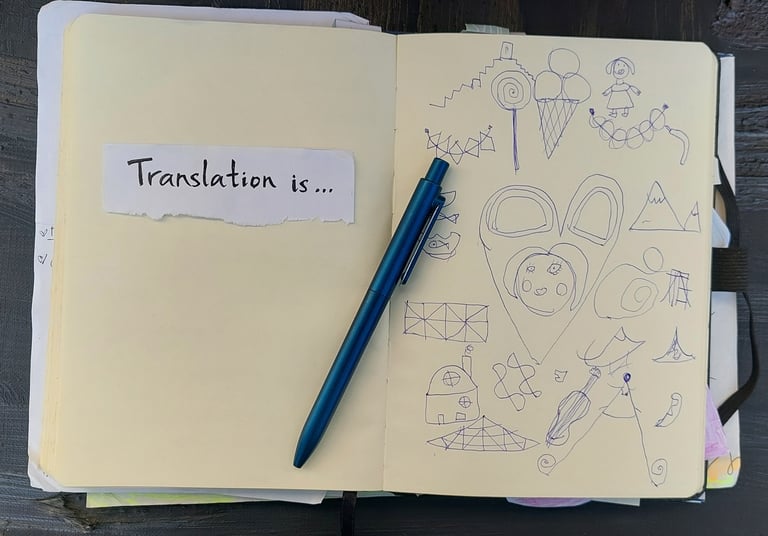
Tímea’s Translation Slam Book
Fidelity is... voice.
Ninja or superhero? Anything that flies.
Full-time job or glorified hobby? Something between the two.
A translation I fell in love with is... Deep Breath by Rita Halász, translated by Kris Herbert.
My favorite translation grant is... the PEN/Heim! 2026 winner over here for Krisztián Marton’s novel Crybaby :)
DROP US A LINE AT
submit@thethirdwheel.org
editors@thethirdwheel.org
© 2025. All rights reserved.
*Your viewing experience may vary depending on your browser or device settings. If you encounter any difficulties, please change your browser or adjust your device settings.