
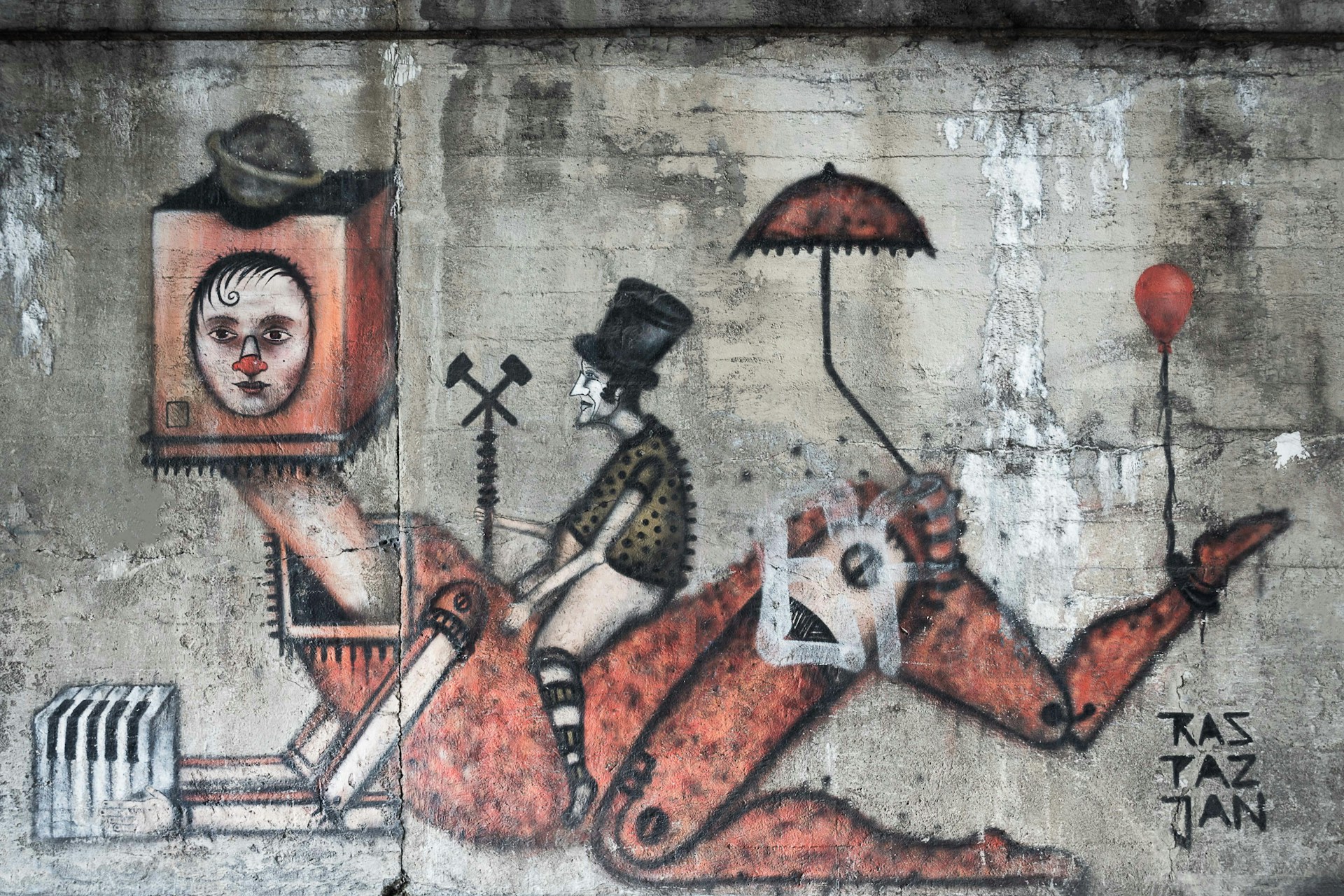
JanBuLena
by Ayesa Khatun
Translated from Bangla by Sritama Halder
JanBuLena was rolling down from the peak of a hillock, making a noise like distant thunder. His body’s rapid, spinning progression was, at one point, arrested by a protuberance with three teeth. The bulge failed to support the weight of his body and promptly sagged, ejecting JanBuLena to continue his journey downwards with all four of his limbs flailing, folding, and bending out of shape. His speed accelerated proportionally to his ever-increasing proximity to the bottom of the hillock. Finally, he landed in the pile of discarded electronics. Now, he could stop rolling and rest. JanBuLena stood up and dusted off his bottom. And right at this moment, he noticed the finger-like flesh growing newly out of his heels—three nail-less, prickly flesh pieces on each heel. He touched them gingerly to see if these flapping things really belonged to his body. Yes, they definitely did; they even hurt if you pinched them.
JanBuLena, the son of a Bengali Brahmin, came of age at a time when India was still under foreign rule. No, I don’t mean the time of the Sultans or the Mughals, but at a time when Lord Cornwallis, meaning a British Christian, was routinely raping India. Right at that moment, he took part in India’s struggle for azadi. Not during the Sepoy Mutiny, oh no. Those sepoys were largely Muslims, after all. That silent intellectual awakening that took place right after the Mutiny—that one. It was the time when he was called Jagat Taran Bandopadhyay. Who knew what uncut diamond the Christian missionaries saw twinkling in the Brahmin boy that they handpicked him to study at Cambridge University, where, later, he married a British Christian called Lena. However, there had been some disagreements regarding Lena’s ancestry. According to some historians, Lena was a Bengali Muslim woman from India, a descendant of the Frog Dynasty from the southeastern part of coastal India. As the case may be, the pure-blooded Christian boys of England were having a hard time in their efforts to accept a Bengali Brahmin boy from India, and thus, Lena descended on the hallowed grounds of Cambridge, picked up the name Jagat Taran Bandhopadhyay, extracted Ja from Jagat, n from Taran, Bu from Bandopadhyay, and mixed her own name—Lena—to the concoction. This was how our man, Jagat Taran Bandhopadhyay, became JanBuLena, a transformation that completely guillotined the Cambridge students’ agitation against inclusion.
This JanBuLena never returned to India except once. Sixty-four years after India gained its independence, when the Hindus, and not the Muslims, were making a ruckus holding the Sachar Committee report in their hands, wheezing loudly that this report was the ultimate scam policy from the state cum State Governments, he was back in India. His intention was to research and find out why Muslims were not barking alongside the Hindus. What JanBuLena found was comparable to those mangy dogs who, when fed large helpings of unaccustomed biryani, lost all hair to reveal their ugly and scabby hides—that was exactly what happened to that damned community sixty-four years after azadi. JanBuLena eventually went back to Cambridge to present his findings, and his department awarded him, with what else but gold medals. This was precisely the reason that the Government of Bengal had beaten the British.
However, that was not the point at all. JanBuLena was now almost 350 years old. Tall like a giant, JanBuLena’s skin color could not be defined anymore. After all, from World War I and World War II to the demolition of the Pentagon, the hanging—no, the decapitation—of Saddam, the mountains of Afghan bones, the earthquake at Latur, to the unique Caesarean delivery with a trident of the pregnant Muslim women of Gujarat, and the displaced humanity from the barrage construction at Farakka, this skin had felt the touch of everything. Unlucky was the person who was cursed by the Mother Land to endure all the afflictions of the world. The end may come only with Armageddon. The knife-like gale of that final storm at the end of everything would decapitate him, and only then may he finally find peace in death. JanBuLena remembered neither the curse nor the means of his deliverance. It was a conscious decision to forget, and it was not easy. Indian blood coursed through his veins, and the gene that carried the essence of yoga had taught him to adapt or acclimatize with time. On top of everything, his height was one of his foremost enemies. The horizontal elevation of his ginormous structure made the children squeak and run in fear.
Now, our man had decided that he would spend his twilight years in India, not in Cambridge. For this purpose, he had erected a cabin by the sea, of course, with the government’s financial and other assistance that was customarily allotted to the Non-Residential Indians.
JanBuLena spent his late afternoons sitting on the little hillock to observe if the sun rose every day or the earth did. All around him, the lava-hot ground baked the featherless fowls that twitched and hopped up and down like demented frogs. JanBuLena was measuring the vertical height of their jump with a satellite from his vantage point. He always thought that the mound on which his rear rested was made of the usual clay, mud, and other unidentified organic debris. But now, as he was busy rolling down its side, his index fingers kept detecting power surges from all those lost Integrated Circuits and forgotten Random Access Memory things; he did not know why it was happening. Finally, understanding dawned on him when he got stuck at the protuberance; his fingers, while clawing about to clutch onto something to arrest further falling, found a fistful of rusted RAMs; he recognized the wrecked computer parts that Europe had subsidized for India. Sacks of rubbish that this country had eagerly welcomed to magically transform her poverty-stricken progeny into toppers in technology. JanBuLena, as described before, crash-landed with the rusty RAM in hand and noticed his three nail-less fingers on the heels. Should he consider this exceptional growth of additional anatomy as the next historical phase of evolution? As he was debating this very essential question, he heard two girls conversing under the Christmas tree.
JanBuLena was immediately struck by the three fingers on both girls’ heels; the tips of the fingers were topped by tiny bulbs—or were they living fireflies? No, why fireflies, of all things? What were these fireflies, anyway? And, why did this word come to his mind in the first place? Had those living diamonds ever existed? Diamonds that nested with the tiny weaver birds on top of the tamarind trees that once dotted the lush pomegranate groves? Firefly. This word—this word with all the gentleness in the world—why did it remind him of weaver birds, leaves and flowers, of yellow ducks and hawks like black dots floating in the sky, of mangrove trees and those tiny pots of kohl, dark and soft, now long gone? This world had forgotten what passion was; emotions were nothing but funny tweaks of hormones after all. Now, eyes had forgotten how to well up with tears—JanBuLena knew it, and yet his thumbs stole quietly to the corners of his eyes.
The two girls, who were more like young ladies, did not have a single stitch on. But this lack of any clothing was almost imperceptible as artists these days had swapped masks or canvases for human bodies. The girls, too, had so many patterns painted on their skins—their chests and stomachs were painted one color while the lower abdomens, waists, and the skin below their vaginas were adorned with another color. Or were they some stray rays of the sun, or the moon, or the stars? Or were they the layers of clouds with just a hint of the case of sour grapes? It was beyond JanBuLena’s understanding. Their conversation was not comprehensible, and yet, in a way, it was—especially when they were using the word “but.” This was how their conversation went. One said, “c.y.b.i.h.s.t.a.m.w. t.a.c.t.k.i.t.s.f.t.m?” and in response, the other one opened her eyes very wide and said, “o.g.h.t.s.o.t n.w.f.t.m n.j!” JanBuLena had known primitive humans in prehistoric times. In fact, he was the one who discovered Mohenjo-daro, the ancient city. He did not even know which historian later claimed the honor. However, he was discarded unceremoniously while the ministers dug up the city, extracted mountains of gold, and went on to win the Nobel Prize. That one minister who did not win had solved the problem by simply stealing it. And so, it did not take long for him to decipher the shorthand language these two girls were speaking in, especially when their pronunciation resembled Pali—the ancient Middle Indo-Aryan language he was already familiar with. After all, in his veins, he still had Brahmin blood with Brahmin genes—the exclusive home to the Bengali language.
The code-deciphering process done, he now understood what they were saying: “Can you believe how silly the ancient mothers were—they actually carried their children in their wombs for ten months.” “Oh God, how tremendously stupid of them. No working for ten months! No jobs!”
This conversation reminded JanBuLena of what Lena, his wife of dubious provenance, once said. If mothers, instead of giving birth, laid eggs and employed nurses to sit on them till they hatched, then they could go about their days unhindered. JanBuLena had shuddered and pointed out that a Bengali scientist from India had once become temporarily famous by growing a test tube baby, but we all knew how the wealthy of this world cannibalized the poor—they stole from the underprivileged. The same thing happened in this case as well. They stamped their own names on the invention, and that poor Brahmin inventor from Kolkata had to kill himself.
Lena had this funny way of laughing off everything, and she had this absolute contempt not only for the Bengalis but for all Indians in general. It should be mentioned here that though once she considered the Indians nothing but mere slaves, she began loving and caring for them in later years. However, when this conversation was happening, she had sneered, “I’ve heard how those refugees from East Bengal, who had to escape to West Bengal, claimed owning coconut and areca groves and large tracts of land, and this and that. Same with these scientists—whatever is being invented in whichever part of the world, Bengalis will jump in to claim it as their own. Remember the fiasco with the radio? Marconi invented the radio, and that fellow, Jagadish Bose, tried to steal the credit for it, ha ha ha.”
JanBuLena’s hand had jerked up; he may have taken a few steps forward, but she was a foreigner after all…
The time of the clone humans had come, shredding the old world of emotions and ideals into oblivion. These two girls were clones, then, with bodies that did not contain hormones—no emotion, no shame. No feeling.
They were holding a matchbox on one of their laps. No, not a matchbox—a laptop. They were watching something from a USB drive—something that was recorded at a seminar. Humans hardly had time to listen to entire papers these days, and thus everything was abbreviated to initials. The laptop was emitting endless garlands of letters—k-ng-ki-mi-chi-l-d-o-l-chi-bng and so on and on and on. No time to waste—read it like this or get lost. Paper readers nowadays took special courses to learn how to speak in letter-words, and those who still wanted to read the tedious longhand must go home to run the letters in slow motion to know what the researcher wanted to say. And these two girls were listening in slow motion to the contemporary analysis of Einstein’s theory of relativity on their matchbox-laptop. In this new world, poems—gone, stories—gone, Rabindranath Tagore—forgotten. Who had the time for all that crap?
JanBuLena suddenly had this irresistible urge to laugh really loudly. Once, in another time, in another world, people used to crowd the Bharat Sabha Hall to talk about the works of Meghnad Saha. The surge of the incoming crowd always increased right before lunch. Only after washing their hands and gobbling up the free food would they proceed to where the discussions were happening. However, fifty years after azadi, everything shifted. The speakers would finish their presentations, announce their next important engagements, and leave with the complimentary food packets. And with their departure, the occupiers of the chairs that stood near the eastern side of the hall would also stealthily clear out. Rumor had it that the speakers brought along their personal sycophants—what if no one clapped at the end of their speeches? Better get your own built-in audience, eh? After the eastern side, the exodus would reach the western side, via the south, leaving only a handful of tenacious attendees scattered melancholily around the hall. The next logical shift brought everything under the umbrella of one single party of self; every man jack of them learnt to declare, “I am the best, I am the supreme one, everything begins and ends in me.” The rest clapped and drank cheap coffee or tea out of disposable paper cups.
A huge tsunami of merriment almost drowned JanBuLena—how clever these girls were, knowledge in slow motion, simply wow! He doubled up in laughter—ha ha ha ha.
Two men were sitting there as well, unnoticed so far. JanBuLena’s raucous mirth drew them out; they, too, were completely naked, what the hell! Their body hair was woven lovingly into suits by one of those expensive salons.
This world lacked not only time, but water had run out, too. No water, no laundry and woven body hair was the only solution. JanBuLena may have grown old in Cambridge, but his boyhood was spent in a village in Bengal, playing boisterous games with the boys who minded goats and cows in the grasshopper-filled noondays. There was Habib, his friend Sajjad’s father, JanBuLena still remembered. JanBuLena often saw him sitting in the cowshed, and like a conscientious eldest daughter-in-law of a joint family, he lovingly mixed crushed oil cakes, fodders, and water into edible concoctions, portioning them into feeding containers while the cows happily masticated. Habib was a master in crafting oversized gloves with their tail hair, which he would wear on his hand and caress the cows’ backs, smoothing their coats as if ironing out wrinkles from clothes. Their big, bovine eyes would close in pleasure. These two men in hair suits reminded JanBuLena of those hairy gloves, and the similitude cracked him up completely—ha ha ha.
Such a sweet sound, such purity echoed in it. The clone humans had never heard anything like it. How was this sound made? The two naked men of this modern time scanned their surroundings. As all four of them came nearer, JanBuLena laughed again—ha ha ha. They tried to imitate the sound, recreate the melodiousness. Ha ha ha? But somehow the racket they made did not really hit the right note. They poked JanBuLena with four long index fingers, and JanBuLena, being ticklish, went hee hee hee this time. It sounded even sweeter to their ears. If poking was the way… they started jabbing each other, jab, jab, poke, poke. But the four new humans did not move, did not budge, did not turn, did not twist, did not shake, did not fold.
Frustrated, JanBuLena stood, arms akimbo, and stared at the sky. The vast dark void above had come alive with thousands of stars. He remembered Lena’s face after a lifetime. Roosters woke up in the nearby Muslim hamlet and sang out cock-a-doodle-dos a little out of sync. JanBuLena started to cry. The four new humans came and stood around him. “Why don’t we laugh? Or cry? Why can’t we smell the flowers?”
JanBuLena’s eyes were overflowing by now. He whispered in his head, “You’re clones. You’re machines. You don’t have mothers, fathers, or grandparents. You’ve never seen rivers flow, streams cascade into waterfalls. Your flowers are made of plastic. No human will ever be born of you.”
Then he laughed the laughter of the ending and howled into the wind, “This, then, is truly the Last Day of All Days. Ha ha ha.”
JanBuLena fell on the ground. Mercy came. He never woke up, but his eyes still cried. The four new humans touched his tears and daubed them around their own eyes and began to laugh.
Ha ha ha.
Photo by Shannon Wand on Unsplash
Ayesa Khatun (b. 1969) was born in Birbhum, West Bengal. She holds an M.A in modern history from the University of Burdwan, and a Master’s in social work from Vidyasagar University, Midnapore. Later, she studied human rights law at the West Bengal National University of Juridical Sciences. She is the founder of a non-government organization (Mohammad Bazar Backward Classes Development Society) in Birbhum, West Bengal. The NGO runs the Begum Rokeya Academy, a residential school for Muslim, Tribal, and Dalit women that focuses on women’s empowerment through education, sports, and leadership.
Starting her literary journey early with poetry, Khatun has produced a diverse body of work, including poetry collections (Nirab Karnaphuli, Khama Hena Hinata Amar, Phirchi Barir Kache), short stories (Phire Aye Phulbou, Faridar Sat Kahon, Phaansh, Jhara Patar Gaan, Chhich Kandune Kathberali o Senur Bandhura), novels (Shaluk o Surudhani, Pora Mukuler Gandha, Bhangan Charita Katha, Roja), and non-fiction (Mayer Katha Mukher Bhasha, Basic Master Karmakatha).
Khatun’s literary accolades include the Begum Rokeya Award (2003), the Sahitya Akademi Travel Grant (2007), and both the Ila Chand Memorial Award from Bangiya Sahitya Parishad and the Young Writers Award from Bharatiya Bhasha Parishad in 2008. Additionally, she received the Bay Pulley Award from Bahuswar Prokashani.
Her contributions to social work have also garnered significant recognition, such as the 2012 Aajker Aparajita award from Rupashi Bangla TV and the 2017 Tomake Selam honor from High News TV. More recently, she was recognized with the Nari Award by the National Minorities Department in New Delhi and the Savitri (2025), among others.
Sritama Halder was born in Kolkata, India. She completed a BA in English from Jadavpur University, Kolkata, and later pursued BFA and MFA degrees in art history at Kala Bhavan, Visva Bharati. She now works as the Reading Facilitator in a Kolkata-based school. She has also been freelancing as an English-to-Bangla translator with the Center for the Advanced Study of India (CASI), University of Pennsylvania, since 2020.
Halder has researched and curated two modules for Sahapedia, an online archive of Indian art, culture, and history: “Sacred Space and Community: A Jain Temple Complex in Kolkata” (with Sahapedia-UNESCO Fellowship, 2019) and “Visual Expressions of the Ramayana.”
Her translated works include Nadine Gordimer’s Nobel Prize acceptance speech from English to Bangla (Nobel Bhashon: Sahityo Asia-Latin America-Africa, Ekalavya, 2018). After being selected for the ALTA (American Literary Translators Association) Emerging Translator Mentorship Program (Bangla to English, 2024), she translated Momin O Momina by Sadique Hossain as an assignment for ALTA. She has translated I Kick and I Fly (HarperCollins India, 2023) by Ruchira Gupta. Her translation of Sadique Hossain’s Bengali short story “Goodbye” was published in Issue 63 of The Bombay Literary Magazine (April 2026 edition).
She has published a number of art history–related and other articles in magazines such as Distinguished, Art Etc News & Views, ArtEAST, and Kindle Mag.
DROP US A LINE AT
submit@thethirdwheel.org
editors@thethirdwheel.org
© 2025. All rights reserved.
*Your viewing experience may vary depending on your browser or device settings. If you encounter any difficulties, please change your browser or adjust your device settings.