
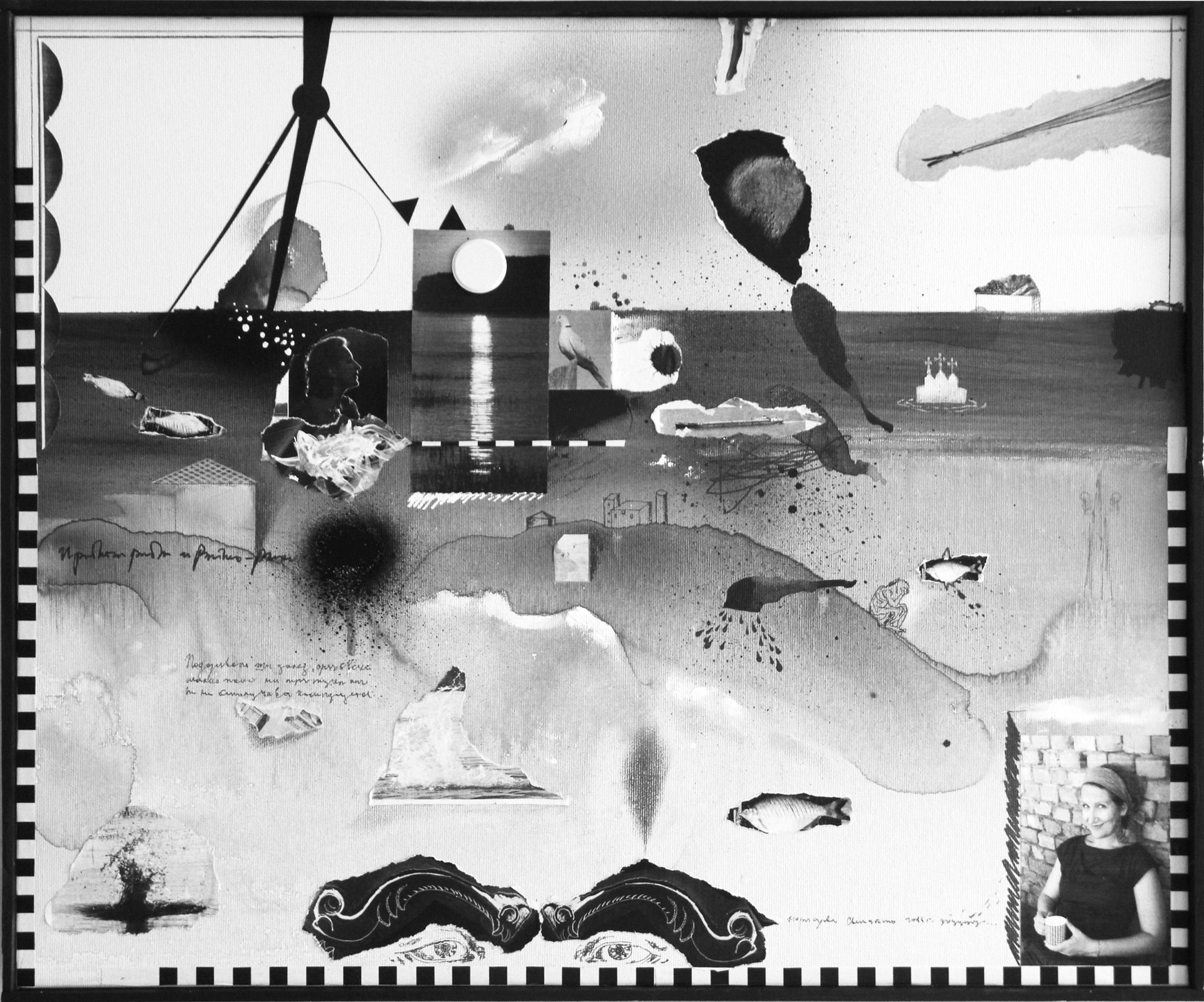
Artwork by Svetoslav Stefanov
Nataliya Deleva’s novel Arrival centers on an unnamed young Bulgarian woman’s experiences of domestic abuse growing up and her struggles as an immigrant and mother in London. After a childhood rent by her father’s violence and her mother’s repeated but doomed attempts to escape, the young woman eventually emigrates to England as a way to erase her traumatic past and reconstruct her fractured self. A layered picture of trauma unfolds through the fragmentary narration, which alternates between her recollections of the past, sessions with her therapist in the present, and the story of her journey from Bulgaria to London and back to Bulgaria, this time with her daughter (though only for a short visit).
The novel dramatizes the immigrant’s double alienation or what Abdelmalek Sayad terms “double absence” from both the former home and the new host country (1999, cited in Hron 2018, 289–290). Here is the narrator on not belonging to either culture:
Later, I ponder socially acceptable behaviour here and there, tracing an invisible border and attempting to find my place somewhere in-between. I still haven’t blended into British society, but I’m also no longer accepted by the land I used to call home. The layers of cultural and social cues pile up on top of each other and this metamorphosis pushes me towards the margins of each of the worlds I exist in. (254)
The narrator reflects on her position as a foreigner both at home (“here”) and abroad (“there”), articulating a sense of liminality––the emblematic “in-between-ness” of those who permanently navigate between cultures and languages, inhabiting at once both and none. This liminality can be traced on the level of the novel’s literary language, which accommodates both Deleva’s native Bulgarian and the language in which she chose to write Arrival––English. Although Deleva originally drafted some initial parts of the narrative in Bulgarian and translated them into English, the book was written in English and published in 2022 by Indigo Press. And, importantly, it furnishes a salient example of contemporary Bulgarian exophonic writing.
Exophony––or the practice of writing in a language other than the author’s mother tongue––is not a recent phenomenon. Yet the term itself was codified only recently, in 2008, by Chantal Wright, who analyzed the German-language literary output of non-native speakers Franco Biondi, Emine Sevgi Özdamar, and Yoko Tawada. After the fall of the Berlin Wall in 1989, with the opening of political and cultural borders, numerous Bulgarians emigrated, and young people chose to study abroad (often with scholarships from prestigious universities). It is not surprising then that a wave of Bulgarian exophonic writing in English emerged in the 2000s, often narrating the immigrant’s or foreigner’s experience, thematizing notions of East and West, new world and ancient culture, home and abroad.
Kapka Kassabova’s memoir about growing up in Bulgaria, Street Without a Name (2008), launched an era of exophonic writing in English about the home country. Krassi Zourkova’s novel Wildalone (2015) narrates a Bulgarian student’s otherworldly adventures at Princeton University while drawing on Bulgaria’s rich folklore, and especially on the figure of the samodiva, the magical woman dancer, who gives the title of Zourkova’s novel as a literal translation of the word “samodiva.” Miroslav Penkov’s short story collection East of the West (2012) and novel Stork Mountain (2016) mine for their plots and settings Bulgaria’s geopolitical history and multicultural, multiethnic borderlands. Arrival enters the stage at a moment when exophony is gaining visibility and legitimacy as both a literary practice and a scholarly field of research. The novel’s bold treatment of domestic violence, trauma, and motherhood through the perspective of a Bulgarian living abroad opens new thematic horizons and expressive possibilities.
In keeping with this perspective, Arrival is broadly structured as an ongoing comparison of past and present. The narrator’s traumatic Bulgarian childhood, denoted by italics, is constantly interjected into the near-past and present of the diegesis, which is written in roman type. The effect is to simultaneously situate the reader in all the tenses of the novel. Additionally, the roman sections include short snippets of conversations with the narrator’s therapist, which then prompt further reflections (both in italics and roman) that ultimately shape the narrative. As a result, the novel takes on many of the features of trauma fiction, with the horrific abuses of the narrator’s father bleeding into the present.
The novel also explores the tension arising from the narrator’s relationship with her daughter, Ka. While the narrator’s traumatic childhood is constantly “present,” she is also raising Ka in a non-traumatic space—outside of Bulgaria, without an abusive father. (In fact, a major turning point in the novel is when the narrator makes the difficult decision to leave her abusive boyfriend, who is Ka’s father, so as to escape what she recognizes as a traumatic loop.) This non-traumatic space is “foreign” to the narrator on two levels: she is both creating an environment for her daughter that she herself never experienced, and is also literally a foreigner in England. But what continues to drive the plot forward is the narrator’s struggle to accept this foreignness, and particularly to accept her daughter’s difference. After an interaction with a teacher at Ka’s school, in which the teacher mistakes the narrator for Ka’s nanny, she writes:
Somehow she was still unable to accept that this woman, olive-skinned, with an Eastern European accent, could possibly be the parent of the white-skinned, very blonde and very English-sounding little girl.
For the first time I was able to see the deep chasm between me and my daughter, the way we were seen by people we greeted every day. Her father’s Britishness had overpowered my otherness in her. I should be grateful to him for this as, living in this country, it worked to our child’s benefit. But I wasn’t. (33)
While the narrator desperately seeks to prevent her child from undergoing the trauma that she herself grew up with, she also at times betrays a secret wish to pull her child back into the past, to subject Ka to what she herself was once subjected to.
However, as the novel progresses, the narrator begins to “arrive” at a healthier understanding of this relationship with her daughter. About halfway through, she steers away from earlier narratives of pregnancy and motherhood as a “burden” and a “fear of [her] own history chasing [her] and repeating itself” (65), and toward a more positively oriented mindset: “I imagined how [the child] would be born soon and how they would become mine: my responsibility, my worries, my sleepless nights. Then, I promised myself to encode only love in them, and no fear” (115). Even later, she writes: “I would do everything possible for pain to elude her” (196), again emphasizing a desire to exit a cycle of abuse. And by the end of the book, she writes: “What’s stopping me? Is it really my daughter who’s keeping me at arm’s length from this version of my life manifesting itself?” (261). Asking this question, with the implied answer, “no,” is the ultimate “arrival,” which “is not a geographical place but a state of mind” (248): that motherhood is hard work, but that it does not have to be subtractive. It can be a life-giving, rather than a life-sucking, force—one that creates a positive loop of love, care, and healing.
~
While the narrator uses motherhood as a way to explore and mitigate her own “foreignness,” we can also locate this tension on a linguistic level. An exophonic reading of the text demands that we pay particular attention to how the narrator’s subjecthood—as a multilingual immigrant, having emigrated largely to escape a traumatic childhood in her home country/language—informs the way that the novel is written. And though the question of language (who is speaking what language, and when) is only directly addressed once in the novel (104–5), the spectre of the narrator’s native Bulgarian haunts both the novel’s content and its form. While the narrator’s English is nearly perfect, there are moments when Bulgarian vocabulary or syntax seeps through the cracks and “makes itself felt,” to borrow a phrase from Wright (2008, 38). The narrator’s choice of verb when she writes about her Bulgarian childhood, “we’d all sit together in the porchway, slurping lentil soup…” (15, italics added), evokes the Bulgarian verb сърбам (“surbam”––to sip loudly), perhaps because of the two verbs’ onomatopoeic origins. The sentence is inflected by the underlying presence of Bulgarian, enabling a multilingual––or perhaps translingual––experience of the text.
We are also left in the dark as to what language is being spoken between the narrator and her daughter, which becomes especially relevant at the close of the novel during their trip back to Bulgaria to visit the narrator’s mother. In these scenes (249–264), Ka seems to communicate fluently with her grandmother, which can only mean that Ka speaks Bulgarian, since we know that the grandmother does not speak English (104–5). Thus we can infer that the narrator has been speaking Bulgarian to her daughter when they are at home, in England, raising her bilingually, and yet she never mentions this piece of her relationship with her daughter—a telling absence in an exophonic reading of the novel. In this light, it is possible that Deleva intends to demonstrate the cultural fluidity of the narrator and her daughter, in which the near-complete elision of clear linguistic distinction instructs the reader to perceive these characters as truly inhabiting the interstices between countries and languages.
The novel is, of course, written in English––a fact which gives a clear dominance to the English language over the Bulgarian spoken and translated within the text. But a traumatic reading of Arrival would suggest that there is also something healing in this repression—that Bulgarian is simultaneously the language of the narrator’s childhood and the language of her trauma, and so to translate or remove it from the English narration is to put some much-needed distance between herself and her past. After all, “to translate is to transform” (Benjamin 1992; Hron 2018, 291), and writers who are “immigrants and refugees seek to identify [pain], describe it, understand it, but also to transform it, or even treat and heal it” (Hron 292). Thus, the fact that the book is in English is significant not because of an “English dominance,” but rather because English, as a non-native, non-traumatic language, is actually the only way for the narrator to provide herself with enough distance from her childhood to narrate it. As Yasemin Yildiz notes, “new languages can open up ‘new intellectual and affective pathways’,” a notion which “differs from presumptions that the mother tongue is always the language of emotion and subsequent languages are merely languages of distance and detachment” (13). She gives the example of Emine Özdamar to illustrate the point, for whom we could easily substitute Deleva: “For Özdamar […] German is the language in which she successfully works through trauma that took place in Turkish, her erstwhile ‘mother tongue’” (13).
The text also formally embodies the translation of trauma through its unusual formatting of dialogue. Dialogue is denoted by dashes in both the italicized and the roman sections of the text. But the formatting of dialogue tags differs between the two. Roman sections use the dash to begin a quote and the end of the paragraph to end the quote. Most often, there are no dialogue tags at all, but when the quotes are attributed, the tags are seamlessly placed within the quotation: “— Only the witches remain childless, my friend continued. You know, only Baba Yaga has no children, but she eats other people’s kids” (78). The dialogue tag is part of the sentence, with no separation (which is typically denoted by quotation marks in Anglophone books) between what is said and the authorial voice describing who is saying it.
But while the italicized sections often use speaker tags, they are always separated by a line break: “— dogs don’t like the meat of a drunken man / grandma said when I told her about it later” (87; the slash indicates a line break in the text). Importantly, these italicized sections contain neither capital letters nor punctuation except for semicolons, commas, and the quotation dashes. Understood through a traumatic lens, the lack of periods is a clear marker of the “unfinishedness” of the narrator’s trauma, which continues to recur in the present even though it is linearly in the past (see Nadal and Calvo 5–6). But this visible detachment of words from speaker calls attention to another facet of the traumatic experience: the problem of representation. As scholars Nadal and Calvo note, one of the defining traits of trauma is that it “resists representation” (3), which, in the context of narration, leads to a “gap between the traumatic event and its narrative, which has to be accessed in an indirect, refracted way” (11)––that is, when traumatic memories are transformed into narrative.
The italicized sections in Arrival invariably contain dialogue that is originally Bulgarian, translated by the narrator into English for the book, so we might think of the detached formatting of the dialogue as an expression or embodiment of that act of translating, of the gap between the memory and its translation into a written foreign language. As Hron notes:
immigrant […] writers are faced with the difficulties of finding linguistic equivalencies for their pain […] The scarcity of a direct language of pain does not mean that there is no viable mode of expression for their pain; rather, like translators, writers must engage in a variety of representational tactics to render their suffering understandable to readers. (292)
Additionally, it is significant that the dash notation, while uncommon in written English, is the standard way of formatting dialogue in written Bulgarian. In Arrival, then, the narrator’s style of formatting dialogue attempts to represent her trauma with a narrative that “mimics the structure of [her] trauma” (Nadal and Calvo 12), while also betraying the vestiges of the trauma itself through the use of Bulgarian dialogue formatting.
There is one crucial exception to the dash format of the quotations, in the segments in which the narrator tells Ka the story of Ivan and Soraya, a Slavic folk tale (43–5, 59, 145–6, 245–6). After falling off the cliffs and disappearing, Soraya becomes a samodiva––a beguiling creature from Bulgarian folklore who ensnares men with her otherworldly beauty and dancing. When telling this story, the narrator employs the usual British quoting format of the single quotation marks (‘’) within dashes: “—‘Soraya,’ he whispered, rubbing his eyes. ‘Is that you?’” (59). The fact that the traditional British quotation format is only employed during her telling of these “homeland” tales is significant in the context of an exophonic reading. Because the quotation format is the “normal,” “natural,” or even “naturalized” format, it seems to connote (albeit quite subtly) a sense of comfort or ease on the part of the speaker. But the story itself is presumably being told in Bulgarian; and even if it is not, it is still a Bulgarian folk tale. Thus, the subtle sense of naturalization that we notice is derived from the presence of the British format, but the content itself is of the “old country,” which leaves us to wonder what is being flipped here: where do we locate “home” in such a complex formulation of identity and language? Returning to our earlier observations on the notion of cultural fluidity, this intricate formatting seems to embody the idea of occupying a truly dual identity.
~
But what happens when Arrival, with all its nuanced negotiations of language and identity in English, is translated back into the mother tongue? The novel is now living a second life in Bulgarian translation, returning, as it were, to its own literary setting, which is also the locus of trauma in the narrative. The process of translating a text originally conceived in the mother tongue but written in English and then translated back into the mother tongue produces a texture haunted by linguistic and semantic ghosts––a haunting that illuminates the dynamics of exophonic writing and its reception back in the motherland.
Deleva’s Arrival was published in Bulgarian in 2025, translated by Ana Pipeva, and with a new title––Пътна връв (Putna vruv). The new title is a neologism and a word play on two pivotal themes in the novel––the journey and motherhood. It inserts the Bulgarian word for “road” (put, път) into the phrase “umbilical cord” (pupna vruv, пъпна връв) so that the ensuing phrase and new title might be translated loosely back into English as Traveling Cord. This inventive title at once successfully captures the gist of the novel and signals its novelty, its vague non-Bulgarian-ness, enacting a generative slippage between languages and therefore exemplifying the linguistic dynamics at work in the novel.
To translate from English into Bulgarian the diegetic events taking place in Bulgarian but written in English is to unsettle the distinction between original and translation, adopted language and native tongue, stable meaning and interpretation. The narrator’s mother, we know, does not speak English, and all interactions with her presumably happen in Bulgarian. Likewise, when the narrator returns to Bulgaria for a visit with her daughter, the child presumably speaks Bulgarian with her grandmother. And most importantly, we assume that the narrator speaks to her daughter in Bulgarian. The result, in translation, is twofold: either a nostalgic domestication of the content when the novel tends to underscore the foreign context; or conversely, a foreignization of the Bulgarian precisely when Bulgarian should sound natural/native. In both cases, the question of spoken language is foregrounded in the Bulgarian translation, whereas it is largely elided in the original.
When, towards the end of Arrival, the narrator suddenly decides to take her daughter to Bulgaria, she tells the bewildered child: “Back, my sweetheart. We are going back” (249). The Bulgarian translation, interestingly, underscores travel as homecoming. It reads: “Обратно, миличка. У дома. Връщаме се у дома” (276). But when we translate this significant quote back into English, we get “Back, sweetheart. Home. We are returning home.” Here, the Bulgarian translation has not only added the language of returning home and repeated it twice, but also inscribed a strong nostalgic reading of Bulgaria as the true home, the trip as repatriation. In a similar Bulgarianizing (domesticating) move, the book of Slavic Fairy Tales (264) the narrator reads to her daughter becomes Bulgarian Fairy Tales (Български народни приказки) in the translation (296), highlighting the presence of Bulgarian and staking a claim about the language the narrator is using with her daughter.
But perhaps the most vivid example comes when the narrator buys flowers from an elderly woman in London (who, the narrator says, resembles Baba Yaga from Slavic folklore). The woman gives her a traditional Bulgarian martenitsa (a red-and-white tassel worn as a good luck charm), saying, “Take it, girl, so you give birth to a healthy child” (165). The narrator wonders how the woman knows about her pregnancy, casting the old woman in the role of a seer. But what remains unsaid in English is whether this woman is Bulgarian, and in what language the narrator speaks with her. Presumably English since there is no mention of another language. But the old woman’s speech becomes idiomatically, authentically Bulgarian in the translation: “Вземи, баба, за здраве” (179) or “Take, baba, for good health” (our translation and italics). This domestication of an otherwise ambiguous linguistic transaction not only omits the reference to the narrator’s pregnancy but it also adds a typical Bulgarian (Balkan and Southern European) apostrophic form of endearment––in this case, the insertion baba. This rewriting of the text recasts the old woman not as a seer but as a speaker of Bulgarian. We can understand this tendency as betraying a desire to re-incorporate Bulgarian identity (and language) into an exophonic narrative that attempts to bypass it; or perhaps as a strategy to bring the text closer to the Bulgarian reader, making him or her feel more at home in the foreign, English-speaking, world of the novel.
Another set of translational strategies adopts a mode of foreignization. For example, when the narrator announces to her mother that she is pregnant, her mother exclaims, “Aw, congratulations!” (159). The exclamation “Aw” in English conveys pleasure, delight, or affection, but its Bulgarian translation opts for an expression denoting fear, pain, or impending disaster: “Олеле, честито!” (“Olele, chestito!”, 172). The interjection Olele! means “Ouch!” or “Oh dear!” and is squarely out of place in the mother’s native-Bulgarian utterance if she is congratulating her daughter on her pregnancy. The effect amounts to a defamiliarization of what should be a perfectly natural phrase. Because the mother within the diegesis is supposed to speak in Bulgarian, and yet her discourse transpires entirely in English, the translated text displays signs of disorientation. What should have been familiar and native becomes strange when transferred from English into Bulgarian precisely because it exposes the tension implied in the original.
If Wright (2008) proposes a reinvigorating defamiliarization as a characteristic trope of exophonic writing, then we might suggest that translated back into the mother tongue, an exophonic text enters the realm of the Freudian uncanny, where the heimlich (the homely, the familiar) becomes unheimlich. In Arrival, the question of who speaks what language is elided or repressed (in Freudian terms), but returns to haunt the Bulgarian translation. The translation repeatedly incorporates the supposedly missing markers of Bulgarian identity or else misses the mark when Bulgarian identity is at stake. In other words, Putna vruv presents a fascinating case study of an exophonic work translated back into the author’s mother tongue, shedding light on some intrinsic or interpretive features of both original and translation.
When examined alongside its Bulgarian translation, the novel offers opportunities for exploring the contact zones between the Bulgarian and English languages, identities, and grammatical structures. On the one hand, the English original offers a compelling narration that at times allows a glimpse into Bulgarian vocabulary, syntax, and typography. The original is haunted by its translingual and translational origins, highlighting the sense of liminality that underpins the novel. The occasional transparency that characterizes the narrator’s discourse and the novel’s formatting can be understood as generative, working towards an innovative style that accommodates new intellectual, affective, and expressive tactics outside the mother tongue. On the other hand, the Bulgarian translation oscillates between resisting and embracing exophony, between heimlich and unheimlich. But perhaps more importantly, in translation Arrival/Putna vruv explores the cultural taboo of domestic violence in Bulgaria, giving voice to the productive, healing encounter between trauma and narrative.
Works Cited
Benjamin, Walter. 1992 [1923]. “The Task of the Translator.” Translated by Harry Zohn. In Theories of Translation: An Anthology of Essays from Dryden to Derrida, edited by John Biguenet and Rainer Schulte. University of Chicago Press.
Deleva, Nataliya. 2022. Arrival. Indigo Press.
Deleva, Nataliya. 2025. Putna vruv [Пътна връв]. Translated by Ana Pipeva. Janet 45.
Hron, Madeleine. 2018. “The Trauma of Displacement.” In Trauma and Literature, edited by J. Roger Kurtz. Cambridge University Press.
Nadal, Marita, and Mónica Calvo. 2018. “Trauma and Literary Representation: An Introduction.” In Trauma in Contemporary Literature: Narrative and Representation, edited by Marita Nadal and Mónica Calvo. Routledge.
Sayad, Abdelmalek. 1999. La Double Absence. Seuil.
Wright, Chantal. 2008. “Writing in the ‘Grey Zone’: Exophonic Literature in Contemporary Germany.” German as a Foreign Language 3:26–42.
Yildiz, Yasemin. 2013. Beyond the Mother Tongue: The Postmonolingual Condition. University of Virginia Press.
Ghosts of the Mother Tongue: Exophony, Trauma, and Translation in Nataliya Deleva’s Arrival
by Stiliana Milkova Rousseva and Max Kassoy
Stiliana Milkova Rousseva (pen name of Stiliana Milkova) was born and raised in Bulgaria. She is Professor of Comparative Literature at Oberlin College (USA), as well as an exophonic writer and translator.
Max Kassoy studies Comparative Literature and Jazz Performance at Oberlin College and Conservatory (USA).
Read More by Stiliana and Max:
Max Kassoy’s review of Marosia Castaldi’s The Hunger of Women, translated by Jamie Richards
Stiliana Milkova Rousseva’s conversation with Izidora Angel, translator of Rene Karabash’s She Who Remains (shortlisted for the 2026 International Booker Prize)
Stiliana Milkova Rousseva’s review of Vera Mutafchieva’s The Case of Cem, translated by Angela Rodel

Stiliana & Max’s Translation Slam Book
Fidelity is… overrated.
Ninja or superhero? Ninjahero.
Full-time job or glorified hobby? Way of life.
A translation we fell in love with is… Jenny McPhee’s translation of Natalia Ginzburg’s Family Lexicon.
Our favorite misconception about translation is… lost in translation.
Money is… one letter short of Monkey.
DROP US A LINE AT
submit@thethirdwheel.org
editors@thethirdwheel.org
© 2025. All rights reserved.
*Your viewing experience may vary depending on your browser or device settings. If you encounter any difficulties, please change your browser or adjust your device settings.