
Many fierce debates took place at the Dakar conference. There was one scholar of French literature who had been living in Dakar for the past thirty years. She was a passionate supporter of Senegalese writers—but her attitude toward them bordered on the paternalistic. At one point, she made a well-intentioned but problematic comment along the lines of: “When you write in French, you must be very careful not to let your language get too rough around the edges. Otherwise, people will label your writing as ‘African French’ [here she used a racist word], and it won’t be taken seriously.” Even though I was listening to her commentary through an interpreter, I could hear the infantilization seeping out through the edges of her words. During the Q and A, Dirk Naguschewski pushed back on her comment, asserting that Senegalese writers were allowed to write however they wanted, and that just because this scholar happened to be a “native speaker” of French did not give her the license to determine what was good or bad French.
In Germany, I sometimes meet people who think they have absolute ownership over the German language simply because they are native speakers. They believe that the German in which Goethe wrote represents the pinnacle of the language, that the German in which Kleist wrote is slightly inferior to Goethe’s, and that the German in which immigrants write is slightly inferior to Kleist’s. I suppose people who haven’t thought too deeply about literature might pick out a word in a text by an immigrant writer and deem it childish. Or they might see a sentence construction they aren’t familiar with and assume it is bad writing. This sort of thing is not uncommon. If the critic and the writer share a mother tongue, the critic will tend to restrain their criticism; whereas if the writer is a “foreigner,” they feel no qualms about broadcasting their ignorant opinions. Sometimes critics feel insecure about their grasp of contemporary literature and choose to project their inferiority complex onto immigrant writers. Perhaps in these cases, they see immigrant writing as something they feel entitled to police, to make sure it doesn’t veer off in the “wrong direction.”
In Japan, immigrant writing isn’t a frequent topic of debate, as it’s not enough of a major genre yet. Of course, there are many writers of Chinese or Korean heritage, but they still fall within the mainstream of Japanese-language literature, and would not necessarily be considered “minority” writers. The only writers that come to mind who have immigrated to Japan and write in Japanese as non-native speakers are Hideo Levy and David Zoppetti. Up until recently, many Japanese people believed it was impossible for someone whose mother tongue was not Japanese to write literature in their language. Levy has written about this phenomenon extensively in his essays.
If a writer decides to write in a particular language, they are under no obligation to use that language in the same way that the majority of its speakers use it. The writer is also not obligated to share the aesthetic sensibilities of their contemporaries. What’s more important is that they uncover some latent potential in the language, which no one had noticed before. Venturing outside of one’s mother tongue is one strategy for revealing the possibility or impossibility of a given linguistic expression. Of course, there are many ways to “step outside” of oneself, and taking up a foreign language is just one.
The most difficult aspect of writing in a foreign language is not the words themselves, but the constant need to battle against stereotypes. Many people—in both Germany and Japan—insist on measuring one’s relationship to a foreign language using only the metrics of good or bad, skilled or unskilled. Turning to someone who has just uttered an incredibly complex aesthetic statement in Japanese, and saying, “Wow, your Japanese is so good” is like turning to Van Gogh and saying, “Wow, you’re so good with sunflowers.” But unfortunately, many people still make comments like these in complete earnest. For some reason, if the writer is a foreigner, it seems the only criterion for judging their relationship to the language they write in is “good” or “bad.”
I think Japanese people often take up the study of a foreign language without thinking too deeply about their reasons for doing so. There, too, “good” and “bad” become the only way of defining their relationship to the language. There is probably a historical reason for this. In Japanese society, European languages (especially English and French) have long been used as a tool to enforce classist ideas. It’s not just that being “bad” at English has implications for one’s future, such as failing the entrance exams and not being able to go to college. There is a way that knowledge of a foreign language is used performatively, to reinforce one’s status. Recently I was reading a Japanese manga and came across the sentence: “This is a French restaurant, so naturally everything on the menu is in French. For high-class customers only!” Learning a foreign language, and spending time abroad, are associated with becoming “high class”—in other words, putting distance between yourself and other, presumably more “ordinary,” Japanese people. It becomes a status symbol, which implies that the authority for determining whether one is “good” or “bad” at a language comes not from within oneself, but from somewhere else. And for Japanese people, that place is occupied by the abstract image of a “Westerner”: It is his authority that determines whether they are “good” or “bad.” This isn’t just rooted in Confucianism—it’s also a colonial idea. In a master-disciple relationship, a teacher is an actual, flesh-and-blood human being—not an abstract idol. However, to revere the abstract image of the “Westerner” as an agent of authority means, simultaneously, to deny the individuality of actual people in Europe and the United States. Actual, living, flesh-and-blood “Westerners” are quite diverse. They are Turkish German, Korean German, Indian British, Vietnamese French, African American, Japanese American, etc. But the concept of the “Westerner” allows Japanese people to completely ignore this diversity and instead cling to an abstract image they have in their head. At least, this was the case in until recently.
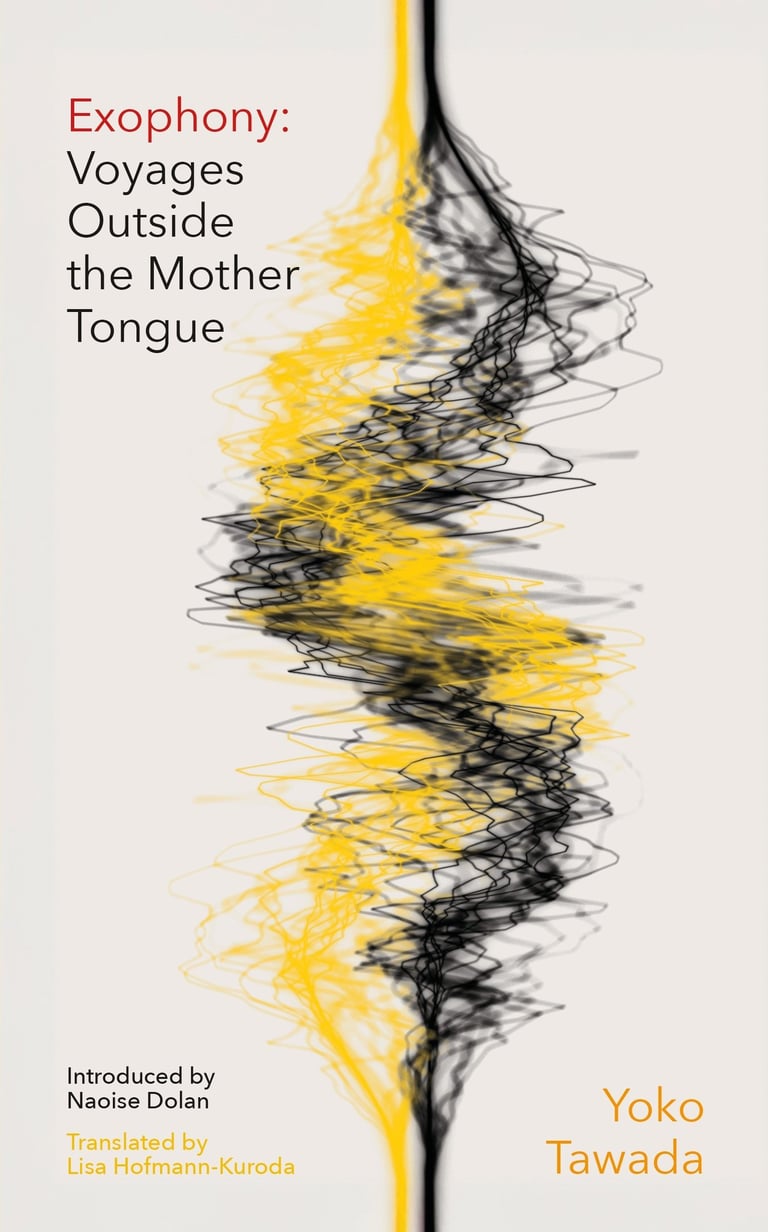
Extract from Exophony: Voyages Outside the Mother Tongue by Yoko Tawada. Translated by Lisa Hofmann-Koruda. Courtesty of Dialogue Books.
DROP US A LINE AT
submit@thethirdwheel.org
editors@thethirdwheel.org
© 2025. All rights reserved.
*Your viewing experience may vary depending on your browser or device settings. If you encounter any difficulties, please change your browser or adjust your device settings.