Exophonic Translators and Volunteer Iowans
Aron Aji and Jan Steyn in Conversation with Ekaterina Petrova
Photo: Ekaterina Petrova
EP: The languages the two of you work with and the directions you translate from and into actually paint an even more complex and less straightforward picture than the already complicated label “exophonic translator,” with which I imagine you both identify, suggests. Could you say a little bit about your languages, how you came to work with them, and when and how you got started in literary translation?
AA: I grew up in a multilingual household in which I was expected to learn different languages in order to communicate with my immediate and extended family. My grandmother insisted that we learn Ladino since, as a transplant into a Turkish city from a small town where a Jewish community once thrived and spoke in Ladino, she felt terribly self-conscious of her broken Turkish. The members of my extended family who were dispersed around Europe and Latin America spoke to us in Ladino and in French, which was then the lingua franca of the Sephardic diaspora. And Turkish was, of course, the national language in which I functioned outside the house. Finally, English was the instruction language of the magnet secondary school I attended, beginning at age eleven. In short, it seems that I have been “working with” my languages, gaining both lexical and existential fluency in them, pretty much all my life.
I decided to become a literary translator in the nineties. I had been studying literature and teaching about it for almost a decade in the US. My wife was an American who spoke French but no Turkish. I realized that I had been steadily losing my footing in Turkish. This was not merely the loss of a vocabulary but also the emotional range I had developed in Turkish, in effect becoming a narrower person. I turned to literary translation to deepen my relationship with Turkish again. Consequently, I was drawn to whom I call language artists, Bilge Karasu, in particular, who is considered the architect of modern (post-Republic) literary language. I don’t exaggerate when I say that I learned everything I know about literary translation through Karasu’s works. A Long Day’s Evening alone—which I had to tackle after translating his first book, Death in Troy, and the one he published afterward, The Garden of Departed Cats—took me six years to complete. During that decade, I also published several shorter translations, different texts by different authors. My work to decipher Karasu’s language naturally saturated the translation techniques I developed. As I say elsewhere, “When I was not translating Karasu, it often felt that I was translating for Karasu, an omnipresent reader.” He still is.
JS: The label “exophonic translator” fits me, but only partially. My mother tongue is Afrikaans; I translate from it into English, which I acquired as a teenager—so yes, in that direction, I fit the description. But I also translate from French into English, which is to say from what one might call (excluding the isiZulu I learned as a toddler and the Sesotho I learned at school) my “third” language into what one might call my “second” language. I came to French late and with some determination: on my twenty-first birthday, someone told me that my brain was already too old to acquire a new language, which I found sufficiently irritating to prove wrong. I’ve subsequently lived in France, on and off, for close to a decade. It was while living there in my mid twenties that I undertook my first literary translation—Alix Cléo Roubaud’s Journal, an elliptical, fragmentary, and deeply personal text by a French photographer and writer who had died at thirty-one. That same period also drew me toward Dutch, which I guess we might call my “fourth” proper language (dismissing the starts in Spanish, Italian, Latin, and Greek I made by taking classes in college). I did so partly inspired by the paths of previous generations of Afrikaans writers, many of whom looked to and lived in continental Europe, especially France and the Netherlands, during the apartheid years, while their Anglophone South African counterparts were more likely to orient themselves toward the UK. Dutch friends eager to share their literary enthusiasms helped too, and Afrikaans gave me enough purchase on the language to teach myself the rest. I have translated from Dutch since, though increasingly rarely, and I have enormous admiration for the small, dedicated community of Dutch-to-English translators whose work I follow closely. And then there is the other direction: I have an ongoing, largely private project translating La Fontaine’s fables into Afrikaans, moving from my “third” language back into my “first”—which was one of the seeds of my chapbook Jig. So, depending on the project, I could be considered an exophonic translator or something else entirely.
EP: In 2016, when I was considering applying to the MFA in Literary Translation at the University of Iowa, I remember contacting Aron, who at the time was director of the program and had recently saved it from dissolving and being shut down, to ask if I was even allowed to apply, as someone who translated from a “small” language (which wasn’t taught at the university) that also happened to be my mother tongue. By that point, I’d already been doing that for over six or seven years, though always with the feeling I was doing something illicit, something I had no business or legitimacy doing. His encouraging response back then and his subsequent mentorship over the next two years, along with that of Jan, who started teaching at the program during my second year, really transformed things for me, so I came out of the Translation Workshop in 2019 feeling much more confident, like I finally had not just the skills but also the legitimacy to translate Bulgarian literature into English. Back then, in my own cohort and in the two cohorts before and after mine that I overlapped with, which probably numbered a total of around 30 people, there was already a handful of us exophonic translators. This spring, when I had the great pleasure to go back to Iowa as a Translator in Residence and lead a multilingual workshop with eleven of the current MFA students, I was pleasantly surprised and very impressed to discover that seven, or nearly two thirds, of them were actually exophonic translators working not just from their native language, but sometimes even from their second, third, or fourth language, into English. I’m certain that this is largely a result of your concentrated and intentional efforts to make space in the program—and by extension in the wider Anglophone literary translation ecosphere—for translators like them (and me!). Do you think this shift also reflects a greater shift in that sphere regarding the norms and expectations about who has the right to translate and into which language? How have things changed, or not, in the span of your own translation careers?
JS: I’ll let Aron address this at greater length, since he has a really good perspective on the broader field. But from the more limited vantage point of our MFA program and the emerging translators who apply to it, the presence of exophonic translators has been robust in the past half a dozen years. We evaluate applications on the basis of the sample translations and other materials, without consideration of which language the prospective student is translating from—though we only accept students translating into English. This almost always results in a good mix of people translating into and out of their so-called mother tongues.
Beyond Iowa, I’ve noticed more panels on the topic at conferences, notably ALTA and ACLA, and edited collections like Kavita Bhanot and Jeremy Tiang’s Violent Phenomena, Madhu Kaza’s Kitchen Table Translation, and Nuzhat Abbas’s River in an Ocean have prominently featured exophonic translators—though the topic, when it arises, tends to be the political dimensions of translation rather than the specific craft challenges that exophonic translators face. The visibility is welcome, and the politics is probably the most pressing part, but there is still a gap.
AA: Yes, the number of second-language translators into English is visibly growing; they have become indispensable for widening the multilingual range of international literature circulation. We are, of course, capitalizing on the insufficiency of first-language translators into English with proficiency in less commonly translated languages, a condition further aggravated by the steady decline of foreign language education in the USA… But as second-language translators, we can also (and in best instances do) broaden the scope of the translation practice itself by mining the generative confluence of multivalent stylistic conventions (lexical, phonetic, graphemic, etc.) rooted in each language and those hybrid strategies invented across languages during the translation process.
EP: Just jumping in to say that the situation with translators of Bulgarian literature into English seems to confirm this broader shift, too. In the first generation to becоme active after the fall of communism, which already consisted of very few people, there was maybe one native Bulgarian speaker. In the subsequent generation, of which I am a part, the handful of us working actively are pretty evenly split between “traditional” and “exophonic” translators. In the next generation, which has really grown in terms of the number of translators, many of whom I’ve had the opportunity to teach, mentor, and work with over the past several years (including two of this journal’s founders!), the divide is very decisively in favor of exophonic translators, with only one or two native English speakers that I can think of actively translating from Bulgarian. But let’s go back to the question about this idea of having a right, or not, to translate from or into a particular language.
JS: On the “right to translate” question, I’ll confess I find that framing unhelpful. Translators have always come to texts through a complex web of affinities, accidents, and ambitions, and authors and editors have always chosen to trust translators with particular projects on similarly varied grounds. It may be genuinely useful to identify systematic bias in those choices—a tendency, say, to favor translators with certain prestigious credentials, or native English speakers over exophonic ones—and to advocate for the kinds of knowledge that get systematically overlooked. But a discourse of “rights” seems too blunt an instrument for the nuance most individual cases actually require.
AA: I just wrote a piece on the subject for an excellent special issue of Mizna, edited by Mona Kareem, on exophone translation. In it, I say, “Translation into one’s native language does not by itself guarantee excellence any more than translating into one’s second language by itself guarantees failure... Rather than asking, What is your native language? I prefer to ask, What is your literary language? In what language have you developed your literary proficiencies, the critical skills and creative tools, the aesthetic repertoire and stylistic strategies, that have in turn shaped your literary writing and translation practices? In my case, the direction in which I translate has had everything to do with the four decades of studying literature, teaching and writing in and about it in English. Even when a person translates beautifully into one’s mother tongue, they do so because of the mature sensibilities and skills they have developed in that tongue (i.e., perfecting it as the instrument and material of their art), not because they were born with it.”
I think other factors have contributed to the shift in perspective about the rights issue. One of the more vibrant arteries in international literature circulation is the festival circuit. Any given month, it seems, an international festival hosts dozens of writers who actually read each other’s work in English translation, many of which are produced in collaboration with each other. EU’s online platform Versopolis actively encourages such collaborative translations. I suspect this practice has also changed the authors’ attitudes about who can or should translate their work. If we can talk about a global literary community, it stands to reason that the translation community, too, is becoming global.
EP: It was actually while leading the workshop this spring that something I have long sensed and suspected was confirmed, and I became able to articulate it more clearly: I’ve come to call it the translator’s constant and endless vulnerability. For exophonic translators, that vulnerability lies in the constant need to prove, to ourselves and the world, explicitly or implicitly, that we have the skills, knowledge, and legitimacy to translate into English, which is not our mother tongue; to constantly question whether the feeling that we’ve gotten the translation of a word or phrase just right might not actually mean that—to quote fellow exophonic translator and another of my beloved teachers at Iowa, Nataša Ďurovičová—we’ve hit the cliché right on the head.
But talking to students in the workshop this spring made me realize that “traditional” translators who are working from a foreign language into their native one—do we call them “endophonic”?—are also just as vulnerable, though in a different way; that they also constantly question, or get questioned about, how, why, when, and where they learned their source language, whether they have enough of a grasp on it, and on the culture and literary context behind it, to translate from it, and whether there isn’t always someone else who’s more qualified, better suited, or more prepared to take on any given translation project. From my own experience, these doubts gradually begin to quiet down as we acquire more experience, but I think they are also worth holding onto and can be quite productive. Questioning ourselves means that we don’t settle for the first solution that comes to us, that we double, triple, and quadruple check things, that we consult experts or seek advice from more experienced translators, that we edit thoroughly, etc., all of which surely makes for better translations. What are your thoughts on this, based on your own personal experiences and on teaching and working with students of translation?
JS: My insecurities as a translator are multiple and varied—and usefully different from one language pair to the next. When I translate from Afrikaans, the doubt is almost too intimate: who am I to carry this language, with all its weight, into English? When I translate into Afrikaans, the worry is different again: that my Afrikaans has been in a kind of arrested development since I left South Africa, frozen at the age I was when I left. When I translate from French, the doubt is more technical: is my English really supple enough to match what this writer is doing? What this multiplicity has given me, I think, is a fairly wide empathetic range in the classroom—I can meet students where they are, whatever the source of their particular anxiety. And what the classroom has given me, year after year, is the reassurance of watching those anxieties gradually transform into confidence and care. It is one of the most satisfying things about this work.
AA: For me, the dictum “translate into your mother tongue” reflects a political anxiety, as if to protect the native language from being contaminated in the hands of non-native translators. I highly recommend Johannes Goransson’s Transgressive Circulation on the politics of translation. We would all (native and non-native alike) be served well by recognizing that translation almost always entails vulnerabilities, because the task of bringing languages into dialogue is replete with risks—of meaning loss, of explicitation, of too much domestication or foreignization, and so on. In overcoming these risks, general language proficiency, no matter how advanced, is not sufficient by itself. The translator’s most crucial skill is how to read the literary language of the source text. And to read it with endless curiosity and openness. Of course, our skills and sensibilities will develop along the way, as any artist’s do. But each source text carries the map of its own translation. We need to experience the event of its newness. To practice, in Master Suzuki’s words, “the beginner’s mind.” I am convinced that overconfidence, more than lack of confidence, results in bad translations.
EP: I’d be very curious to know if you notice any interesting differences between the translation processes of exophonic translators and those of translators working into their native language. I’m not really interested in labeling one as necessarily superior to the other, but in whether—and how—the translation methods, approaches, and strategies, as well as the resulting translations, might differ when done by somebody translating into—as opposed to from—their second (or third, or fourth) language.
JS: I’ll be honest that I don’t have a great deal to say on this question from a theoretical standpoint—but I do teach a French-English graduate translation class where work goes in both directions, and what I find consistently gratifying is watching students who are more confident in one language get their turn: as better informants about the source, or as more fluent producers in the target. The roles shift, and everyone gets to experience both sides of that.
What I’ve come to believe, watching students over the years, is that the hardest thing to learn is knowing what you don’t know—developing an intuition for when to consult a source-language dictionary, when to look something up in images, when to reach for a target-language grammar or style guide, when to ask a native speaker. There is no shortcut for this. It grows out of practice, trial and error, and a deepening familiarity with resources—paper, electronic, human—and their particular limitations in a given language.
This is what worries me most about the current noise around machine translation and generative AI as democratizing tools for either exophonic translators or translators with limited command of the source language. Translators who rely on these tools too heavily may not be clocking the hours required to develop that sense of intuition that I think is so crucial. They may not even notice what it is they’re missing
AA: It is nearly impossible to speak categorically about the differences between native and non-native translators, since each translator, no matter their language position, brings to their practice different assets and liabilities. So, no theories on this. I can only speak of tendencies I have seen over the years. In the essay I wrote for Mizna, I offer a partial menu of these tendencies: “the exophone translators arrive to our workshops with a reflexive, intuitive familiarity with their source language. Because they have a relatively extensive experience with the spoken language, they can discern the emotional effect of sounds and rhythms on the meaning of a word, phrase or sentence. At times, however, the exophonic translator risks conflating their “confident” familiarity with their native language, on the one hand, and the deliberate manner in which the language specific to the source text ought to be experienced, on the other… In the early stages of translating to their L2, the exophonic translator may also have a formal (read: schooled) or intellectual relationship with the target language. The language specific to their translated text may cleave too closely to the formal grammar of English, and if they are self-conscious when using English, their translation can show an over-avoidance of creative interventions. In the course of their development, the task for the exophonic translator is to become less self-conscious and more self-aware, to hone their assets through critical and reflective practice.”
EP: And related to this, how do you think being an exophonic translator affects working with editors, specifically in the Anglophone publishing sphere? In my experience, it has actually been an asset, as Anglophone editors usually do not have access to the original language, especially when that language is “small,” such as Bulgarian. So the responsibility falls entirely on me to make sure that subtle but significant things from the original do not get lost in the process of translation and the subsequent process of editing. Although, of course, I’m always, and simultaneously, worried about not getting a certain preposition, an idiom, or even punctuation, right—though those things are much easier to catch and fix by an editor.
JS: My sense—and I’ll admit it’s limited—is that while exophonic translators are now quite common, exophonic editors remain very rare. That asymmetry matters. I’ve advised exophonic students and colleagues who have had a wide range of experiences with editors, from genuinely supportive to frankly condescending.
If I have a tic, it’s that I keep fixating on the range of Englishes in play. Editors can be quick to flag the work of exophonic translators as somehow non-fluent, when what they may actually be encountering is English that is perfectly fluent—just on a different continent, or in a different country, or even a different region. The assumption that there is one standard of English against which a translation should be measured, and that deviations from it signal the translator’s inadequacy rather than their different but entirely legitimate linguistic formation, is one I’d like to see challenged more forcefully in editorial culture. And that’s before we even get to Lawrence Venuti’s famous concern that the original might not be particularly “fluent” either.
AA: I agree completely with Jan. When you and your editor Muhua Yang spoke to our students about the editing process of Iana Boukova’s Traveling in the Direction of the Shadow, I was delighted to hear that you began your collaboration by dialoguing on a small portion of the manuscript so that you could identify the stylistic priorities of the source text and the corresponding strategies you devised in translating it. Fortunately, preliminary dialogues like yours are becoming more common nowadays. It’s in large part thanks to the “visibility of translator” movement—the rich array of craft-essays, notes, and prefaces written by translators in the last decade or so—that editors and publishers are approaching translation on its own artistic and technical terms.
EP: I totally agree with you, Aron. Both on what you said earlier about encountering each text anew and devising translation strategies according to its specific demands, rather than according to some grand idea of “how we should translate,” and on the importance of communicating those demands and strategies when you first begin working with an editor, so that they’re aware of them.
My final question to both of you is about emerging exophonic translators. What advice do you have for people who haven’t yet started but are considering going into literary translation into English if English is not their first language?
JS: Do not ask for permission. Do the work to build intuition. Translate with big ambitions. And, when it comes to prejudiced readers (and editors), Muriel Spark had it right: “Never apologize, never explain.”
AA: Yes, though, maybe keep explaining, since there is still much we need to learn from each other’s practice. Other than that, choose projects commensurate with your passion, ones that dare to alter the course of literature in your language, ones that may, in turn, make English more capacious when speaking for our tongues.
When I was a graduate student at the MFA in Literary Translation program at the University of Iowa, among the many texts we read was Paul Ricoeur’s collection of three essays, On Translation. In it, Ricoeur introduces the concept of “linguistic hospitality,” where, in Eileen Brennan’s translation, “the pleasure of dwelling in the other’s language is balanced by the pleasure of receiving the foreign word at home, in one’s own welcoming house.” I remember wondering what that meant for me, as a translator from my native Bulgarian into English, which I’d learned as a teenager, and for cases similar to mine, where these concepts of “foreign”/“home” and their meanings are not straightforward, but somewhat upended or—though often not symmetrically—reversed. We read Ricoeur as part of Issues in Translation, the foundational theory class taught by Aron Aji, the program’s director at the time, who was born in Turkey and translates from his native Turkish (although, as I came to eventually find out, his “mother tongue” was technically Ladino). It was largely thanks to Aron that I finally started feeling that my practice and professional existence as an “exophonic translator”—a term I first learned from him—was valid and legitimate, rather than something I needed to overcome or conceal. That sense grew stronger in my second year, when Jan Steyn, who was born and raised in South Africa and whose work as writer, translator, and scholar of world literature spans Afrikaans, French, Dutch, and English, joined the program as a professor, and I had the opportunity to take part in a workshop he led.
This spring, exactly seven years after graduating from the MFA in Literary Translation, which in the meantime celebrated its sixtieth anniversary, I had the immense pleasure and privilege to return to—and temporarily dwell in—Iowa City as a Translator in Residence and lead a multilingual workshop with the current, impressively brilliant students in the MFA program, now directed by Jan. I was once again reminded of Ricoeur’s concept of linguistic hospitality by an act of very literal hospitality on Jan’s part, when he and his partner, the writer and translator (and amazing chef!) Caite Dolan-Leach, hosted a welcome dinner for me at their home. The dinner was attended by Aron, who had just announced his retirement from the program, a few more of my former professors, several translators who had started teaching at the university’s ever-growing translation programs after I’d left (some of whom were graduates of the program themselves), and a couple of translator friends who were back (or still) living in Iowa City. It occurred to me then, during this welcome dinner for me in a place that felt like home in at least as many ways as it wasn’t actually home, that all of us—regardless of whether we’d come from New York or California, or from across the border in Canada, or from more faraway places, such as Turkey, South Africa, Slovakia (via Sweden), Azerbaijan/the Soviet Union (via Chicago), or Bulgaria—were, whether briefly or for the long haul, “volunteer Iowans.” This is the term with which Jan describes himself in his beautiful chapbook Jig (excerpted here), playfully nodding to how the word “volunteers” is used in Iowa in reference to plants, whether “invasive” or “native,” that appear spontaneously, against the gardener’s intent, in a garden.
It also occurred to me, not for the first time, that while I love Ricoeur’s idea of linguistic hospitality, the reality of literary translation proves, again and again, that the concepts of “foreign” and “home” aren’t always neatly delineated and can’t always be clearly defined, nor are the ways in which we, as translators, move between the two, or dwell among them, always unambiguous, straightforward, or one-directional. Looking at the hosts and the guests around that dinner table in Iowa City, it also occurred to me that, in addition to “the pleasure of dwelling in the other’s language [being] balanced by the pleasure of receiving the foreign word at home, in one’s own welcoming house,” we can also take pleasure in dwelling in our own language while accompanying it to and then sending it off into the other’s welcoming house, which is also, somehow, our own.
These thoughts were confirmed when, after holding the first nine sessions of our workshop at the university’s Phillips Hall, which houses the translation programs’ offices and classrooms, I hosted the translation students for our final workshop in the cozy Historic Phillips House, where I had lived during my five-week residency. There I was, a Bulgarian translator into English, experiencing the pleasure of welcoming into my (albeit temporary) home in Iowa City translators from Bangla, Finnish, French, Hindi, Igbo, Italian, Latin, Norwegian, Russian, Sanskrit, and Spanish. Some of them were originally from the places where these languages are spoken, some weren’t, and some were straddling the two or moving between them and a few other linguistic traditions.
Now I sit at my writing desk back in Sofia for a virtual conversation with Aron and Jan on the nature of the beast that is exophonic translation, on how (and if) things are chnaging for exophonic translators, and on the endless vulnerability of translators, both exophonic and not.
—Ekaterina Petrova
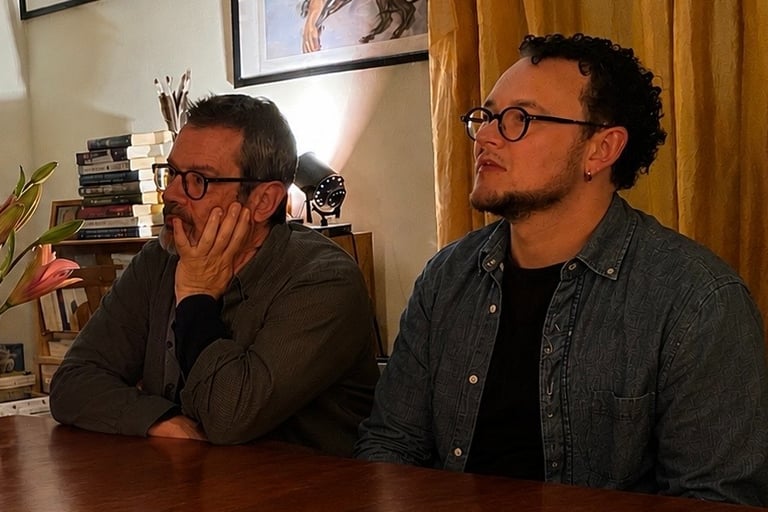
Photo: Ekaterina Petrova
Read More by Ekaterina:
“Neither Here and There: The Misery and Splendor of (Reverse) Translation” (an essay on translation, published in Reading in Translation)
“Iana Boukova, or The Relentless Search for Meaning(s)” (an essay on Iana Boukova, published in Asymptote)
Excerpt from Iana Boukova’s Traveling in the Direction of the Shadow (a translation and a translator’s note, in Exchanges: Journal of Literary Translation)
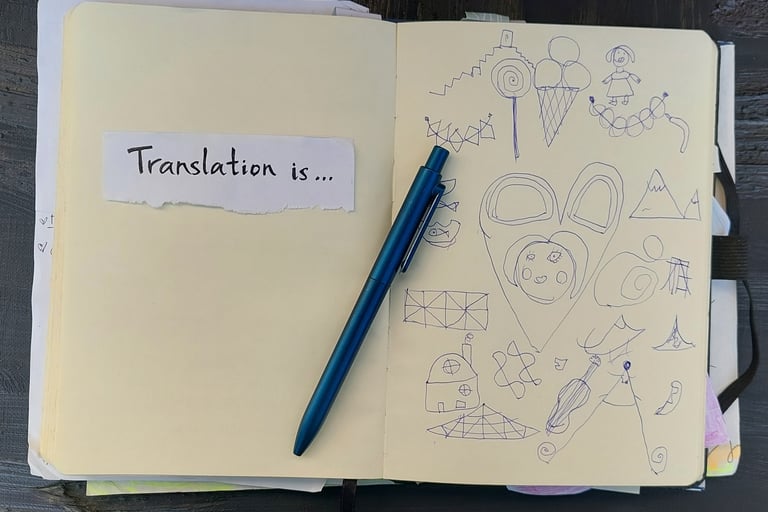
Fidelity is… essential, though in a more metaphysical sense, so fidelity to the spirit, soul, and intentions of the text, be they stylistic, linguistic, or content related. Not fidelity in the sense of having to translate word for word or sentence for sentence.
Ninja or superhero? Superhero in a ninja disguise.
Full-time job or glorified hobby? A glorified hobby that for me somehow—miraculously—turned into a full-time job. Sometimes I still have to pinch myself to make sure that this thing that I love doing so much really is something I get to do as my job.
A translation I fell in love with is… I fall in love with translations all the time. One of my all-time favorite books is W. G. Sebald’s The Rings of Saturn, which I read in Michael Hulse’s English translation. More recently, I was blown away by Sophie Hughes’s translation of Hurricane Season by Fernanda Melchor. From my own work, I think I’ll forever be in love with Iana Boukova’s Traveling in the Direction of the Shadow, which I’ve been working on for the past eight years and which has taught me so much of what I know about reading, writing, and translating. It’s finally coming out this fall!
My favorite misconception about translation is… that it just springs up, basically on its own, that there isn’t an actual living and breathing person—who is not the original author—behind it, whose experience, energy, and thoughts have gone, sometimes over months and often over years, into selecting every single word of the translated book we’re reading.
Money is... not the reason why anybody goes into translation. Which, of course, doesn’t mean that translators shouldn’t be compensated for their work fairly.
Ekaterina’s Translation Slam Book
DROP US A LINE AT
submit@thethirdwheel.org
editors@thethirdwheel.org
© 2025. All rights reserved.
*Your viewing experience may vary depending on your browser or device settings. If you encounter any difficulties, please change your browser or adjust your device settings.