

“When translating from a non-native language, you never really know what it is that you just read,” Tim Parks said in his keynote address at the 2017 American Literary Translators Association conference (quoting from memory). It was my first ALTA conference, and I didn’t expect such a humble admission from a notable translator (now I wouldn’t be surprised). It was quite comforting to hear, because I could easily invert the sentiment to “When translating to a non-native language, you never really know what it is that you just wrote,” and—hooray!—I didn’t have to feel inferior anymore as a translator into a non-native language! We be of one blood, exophone or endophone.
For a long time I’d been convinced that one should never even attempt to translate into one’s non-native language. There’s no chance, I thought, that anything good could come out of it. Looking back at myself, though, I realize that the very fact that I felt so strongly about it indicates that I’d always wanted to do it. I just didn’t feel that I could. And then something changed. It was a classical Hegelian quantity-to-quality trick: once I’d translated enough English poetry into Russian (in the tens of thousands of lines), at some point I felt I was finally getting the hang of how it worked.
In fact, it’s not easy to explain what I mean by this. A lot of what we take for granted in poetry is a matter of convention. There is no “natural” reason for, say, inversion or enjambment to be acceptable or unacceptable in poetry. It’s about conventions, and they change with time. To a native speaker, the currently active conventions feel “natural” to the point of not noticing them. But a translator working with poetry of different eras, in my case from the sixteenth to the twenty-first centuries, needs to both internalize and rationalize these mutable unwritten rules in order to understand what sounded natural vs. marked (foregrounded, defamiliarized) to the intended reader of the poem. When I first approached Shakespeare’s sonnets, I discovered that I had no idea how to read them aloud. Their rhythm didn’t work for me. I tried asking native speakers, but those who were at hand at the time (fellow programmers) couldn’t help much; they didn’t know either. Perhaps I didn’t even realize then that a diphthong was to be pronounced as one syllable. Or, more likely, I knew that rationally, but couldn’t translate this knowledge into acoustic performance. More importantly, I didn’t realize that the rules for allowed stress patterns in iambic pentameter were very different in Russian and English (there are some good reasons for that, as well).
Some things do naturally follow from the language’s prosody, like the alliteration of repeated initial consonants in English. For several reasons, initial consonants in Russian carry much less acoustic weight, and the Russian ear is not attuned to such alliteration. At first, I couldn’t understand why alliteration even mattered, but gradually I learned to hear it (translating Gerard Manley Hopkins helped a lot). There are many such things. A Russian translator friend used to joke that English is a language where anarchy rhymes with democracy. To an untrained Russian ear, this sounds utterly absurd: the only matching sound is not even stressed! (Russian has almost no secondary stress, even in very long words, and scorns rhymes with no matching consonants.)
So I started to feel that I was getting the hang of how English poetry worked, and that in some respects it worked quite differently from Russian poetry, and I got curious about translations of Russian poetry into English. I guess the idea was to quickly make sure there was nothing for me to do there and forget about it. But what I discovered was a rather sad state of affairs...
...I should put a REALLY HUGE caveat here: when I say I don’t like a translation, that means it doesn’t work for me, and nothing else. It may be a wonderful poem, it may work beautifully for many other people, it may be great for all and any purposes except just one rather insignificant purpose—to give me something that I want. Why would anyone care about giving me what I want, besides myself? There’s no reason. But it’s important to me, of course...
...Unfortunately, most of the translations I looked at didn’t work for me. Either they didn’t sound Russian enough, or they didn’t sound English enough, and I wanted them to do both somehow. So, if you know so well what you don’t like, I said to myself, then it’s upon you, my dear, to make something that you will like. And I decided to give myself a really hard test by translating a poem that’s so iconic that if one wanted to select one poem to represent the entire Russian poetry, this one would be selected. This arch-poem, The Poem, is to Russian poetry what apple is to all fruit, oak is to trees, and sparrow is to birds: quick, name a poem—Ya vas lyubil (“I loved you”) by Alexander Sergeyevich Pushkin (of course). I thought if I could do a reasonably good job with it, then it might make sense to continue. There were a couple of specific things I wanted to do in this translation that existing translations didn’t quite give me. I wanted the language to sound natural and almost contemporary, to avoid any syntactic contortions, to rhyme well, and to end with a word that would match the Russian drugoj (“another person, someone else”)—I hope you’ll see why when you read my translation:
I loved you once; the flames that burned before
Have not, perhaps, died out within me yet.
But let it not concern you anymore:
I would not think of making you upset.
I loved you with no hope, no word, no art,
From shyness plunging into jealous spells,
I loved you with such tenderness of heart:
God grant you love like that from someone else.
1829
It is a decent translation, I still like it. It’s not without flaws, of course; “spells/else” is not a nineteenth-century rhyme; there’s something wrong with the fourth line, which I can’t quite put my finger on, etc. But I like lines five and six a lot (in particular, I’m happy about phrasing the negation in an idiomatically English way, different from the original), and “else” hits the nail on the head as the very last word.
That’s how I decided to start translating into English in earnest. With my imperfect English, I depend on the feedback (and pushback) from native speakers. I can’t thank them enough, my fellow translators and friends who take the trouble of reading and commenting on my stuff. It’s vital because I want my translations to appeal to native
English readers, for the sake of the poems I translate. But there is a critical tradeoff involved, which is worth discussing at some length. As we recreate a poem in
another language, to what degree should we also recast it into forms familiar to the target language reader? This question probably arises for every language pair in
different ways, but for Russian/English, it is very conspicuously about translating form: meter, rhyme, even equilinearity.
English and Russian poetry ran out of fresh exact rhymes at about the same time, by the end of the nineteenth century (even though English had had a much longer run with them). In fact, even in the early nineteenth century, Pushkin joked in Eugene Onegin about hackneyed rhymes, and elsewhere predicted that Russian poetry would adopt blank verse, because there were too few rhymes in the Russian language (sounds familiar, huh?). However, subsequent Russian poets chose to reform rhyme instead of abandoning it, and embraced rich, though inexact, sound echoes. Likewise, with respect to rhythm, the history of Russian poetry is the history of the steady expansion of its metrical toolbox, so that the contemporary poetic landscape covers all the territory from strict accentual-syllabic meters to free verse, with everything in between, and all kinds of rhyme or lack of rhyme in all possible combinations.
The common translation practice of rendering everything in free verse obviously takes away much of the richness of this landscape. Or one can say that by erasing some of the differences between poems, it strips them of some of their individuality. But how critical is it? I suppose being an exophone makes me especially sensitive to the form of the originals. To me, free-verse translations are self-evidently inadequate, but I have been asked many times by native English speakers what the point is of trying to recreate the form. Rhyming, the conventional wisdom says, immediately marks the poem as outdated or comical. Meter sounds singsongy, monotonous, boring. The exigencies of form force unnatural or archaic turns of phrase. This is not the way to appeal to the reader.
This is all true. Or, rather, these are all real dangers. And yet, I believe that the English language is rich and flexible enough to make formal translations work even in contemporary poetry. Without boring the reader with technical details, I just want to give a flavor of my argument here. First, and perhaps the most important, is that there are examples of modern and contemporary “serious” poetry (that is to say, not focused on entertainment value alone) effectively using rhymes. Beyond the canonical examples of Robert Frost and Dylan Thomas, even in my very limited translation practice, there’s the striking example of E.E. Cummings, a modernist par excellence, who wrote rhymed, metered—and still modernist—sonnets, such as “i like my body” (1925). Granted, it was a hundred years ago, but there are recent examples, such as the 2006 poem “up from slobbery” and other works by Harryette Mullen, a wonderful poet and a recipient of the Gertrude Stein Award for Innovative Poetry, among other prizes. It doesn’t matter that such examples are in the minority; they are enough to prove the possibility.
A common argument against rhyming is that because of the strict word order in English, it is much harder to put the word you want to rhyme at the end of the line, so you have to resort to syntactic inversion, which immediately places the text in the wrong century. But in contemporary poetry, a line doesn’t have to be a complete syntactic unity, so a poet is free to break it anywhere, even between a preposition and its noun (enjambment), and that more than makes up for the ban on inversion. Also, there’s no reason why English couldn’t make wider use of rich, even if inexact, rhymes, such as slobbery/hyperbole from Mullen’s poem above.
The issue of the singsonginess of meter is perhaps one of the subtlest and hardest to get right for an exophone. On the one hand, Russian and English use nominally the same accentual-syllabic principles, and many of the meters are functionally quite similar. For example, iambic pentameter is the meter of dramatic blank verse in both
traditions, and trochaic tetrameter tends to feel light and cheerful in both. On the other hand, the actual rhythms can be quite different, as well as the rules on what is considered “correct” realization of a given meter. In addition, many meters fairly common in Russian are unheard of in English, such as trochaic pentameter (though,
again, there’s no technical reason why it couldn’t be used).
All of this bears immediate relevance to the two poems by Olga Koltsova I present in this publication. Koltsova is a poet, translator (from German and English), and journalist. She is the 2008 laureate of the Silver Age literary prize, awarded for “contributions to preserving the traditions of the Russian Silver Age in contemporary literature.” Koltsova writes, loosely speaking, in the French and Russian Symbolist tradition. Her imagery is oblique and obscure; it is driven by dream-like logic and the flow of sound. Koltsova’s poetry is sometimes dark, sometimes playful (and often both), but always very beautiful. These poems are rhymed and metered: one is in anapestic pentameter, very unusual in English, the other in a version of the English ballad meter, but anapestic. I feel that their form is a large part of their appeal. You want to read them aloud. Three more Koltsova poems in my translation can be found on the Articulation Project website.
I don’t like to explain poems or discuss “translation choices.” I believe that a translation must be able to stand on its own legs, and that you don’t have to fully understand a poem to enjoy it: “an essence wells up between lines,” as Koltsova writes in one of her poems. But if I may end this essay with an appeal, I’ll say: write to me! Returning to the quote from Tim Parks, I don’t really know what it is that I wrote in these translations, but you can tell me. Do please, and maybe I can learn something new to get a little better at this hopeless enterprise, or at least we can have an interesting conversation.
“Essence Wells Up Between Lines”: Two Poems by Olga Koltsova
by Dmitri Manin
Olga Koltsova is a poet, translator, editor, and journalist. She graduated from the Journalism program at Moscow State University and has been publishing since 1978; as a poet since 1987 (mostly in Russia and the USA). Olga published translations from German (Wilhelm Busch, A. Margul–Sperber, W. Eichelburg) and English (R. Fergusson, J. Keats, O. Wilde, R. Kipling et al.) Her own book of poetry, Nesvoboda (“Unfreedom”), which came out in 2007, won the prestigious literary prize Silver Age, awarded yearly for “contributions to the preservation of the Russian Silver Age traditions in contemporary Russian literature.”
Dmitri Manin’s poetry translations from Russian have appeared in journals and anthologies, including the inaugural volume of Best Literary Translations (Deep Vellum, 2024) and two anthologies of Russian anti-war poetry: Disbelief (Smokestack Books, 2023) and Dislocation (Slavica, 2024). He co-translated and co-edited Firefly in a Box: An Anthology of Soviet Kid Lit (UPM, 2025). Nikolai Zabolotsky’s Columns (Arc Publications, 2023), in Manin’s translation, was shortlisted for the Northern California Book Award and ALTA First Book Prize.
Read More by Dmitri:
Columns (a poetry collection by Nikolai Zabolotsky, published by Arc Publications)
Poems by Julia Nemirovskaya (published in Articulation Project)
Firefly in a Box: An Anthology of Soviet Kid Lit (co-edited with Anna Krushelnitskaya, published by University Press of Mississippi)
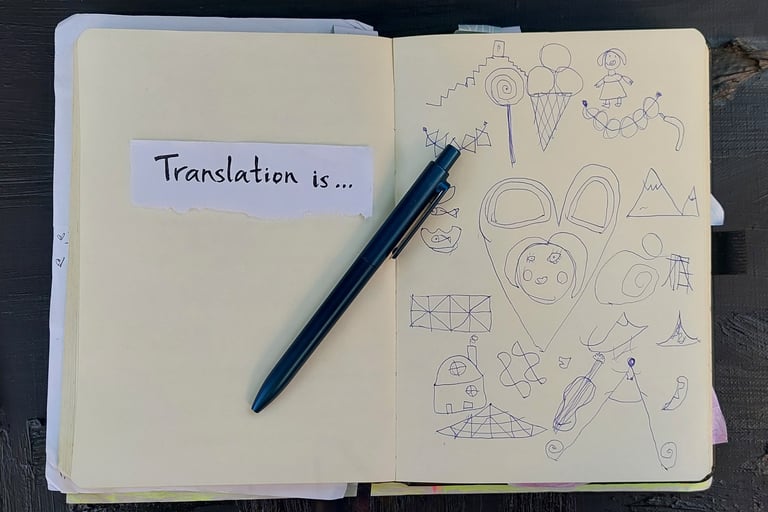
Dmitri’s Translation Slam Book
Fidelity is… beauty.
Ninja or superhero? Watchmaker.
Full-time job or glorified hobby? Certainly not glorified, no.
A translation I fell in love with is… Boris Zakhoder’s Russian Winnie-the-Pooh.
My favorite misconception about translation is… that it’s all about “choices.”
Money is... unfortunately.
DROP US A LINE AT
submit@thethirdwheel.org
editors@thethirdwheel.org
© 2025. All rights reserved.
*Your viewing experience may vary depending on your browser or device settings. If you encounter any difficulties, please change your browser or adjust your device settings.