Artistic Risk as a Commercial Proposition
A Conversation with Pascal Nguyễn and Kim Trần from Major Books
TTW: Let us start from the beginning. How did Major Books come into being? What inspired you (or maybe convinced you) that Vietnamese literature needed a dedicated publishing home outside Vietnam? Was there a particular book or author that sparked the idea for the press, or was it a more general “gap” you were trying to fill?
KT: The honest answer is absence. You could walk into a bookshop or a university library, places that are supposed to hold the breadth of human expression, and find an extremely narrow, certainly skewed, representation of Vietnam. Often, one finds the same two or three titles, most of them circling war or food and tourism. They reflect a very Western perspective of Vietnam; one that denies our ability to produce high culture, reducing the country to an exotic subaltern waiting for discovery by the brave white; or casting us as victims of imperial violence still in perpetual recovery. In the way that Vietnam has been situated within the global publishing scene until Viet Thanh Nguyen and Ocean Vuong claimed the place for “Vietnamese literature” in the Western consciousness, ten-odd years ago, it was seen that “we” don’t write, “we” are written about.
I grew up surrounded by Vietnamese literature, and I knew with absolute certainty about books that were extraordinary. Novels that were funny, formally daring, morally complex. Poetry that had nothing to do with bombs or their aftermath. Folk tales with female protagonists who were cunning and sovereign and not defined by their suffering. Those books do not exist in English.
PN: We felt this absence was not an accident; it was structural. The publishing industry has enormous inertia and amplifies what is already accepted. Vietnamese literature has not had the institutional backing—cultural diplomacy, translation prizes, academic infrastructure—to push it on the radar of buyers in London or New York. We decided to stop waiting for someone else to notice and start building the infrastructure ourselves.
TTW: So, having this in mind, how do you define your mission as an indie publisher working in translation, and how has that mission evolved since you began?
KT: Our mission statement is straightforward: to bring Vietnamese literature to the English-speaking world with the integrity and ambition it deserves. What has sharpened over time is the editorial ambition behind that. We want to bring a catalog that argues for something—and not simply add a few Vietnamese books as a footnote or an exotic supplement to a reader’s diet. We want to show that Vietnamese literature has its own formal traditions, its own satirical lineage, its own queer voices, its own avant-garde. Our evolution has been towards greater curatorial confidence and, honestly, greater provocation. We are now consciously asking what is the book that challenges the assumptions a reader has. That is a more interesting mission than simply filling a gap.
TTW: How do you choose which works to translate—what qualities make a manuscript feel urgent or necessary to bring into English?
KT: Literary merit is the non-negotiable starting point. We will not publish a book because it is “accessible” to readers unfamiliar with the culture or because it fits a narrative that Western readers find comfortable. That would be a form of condescension.
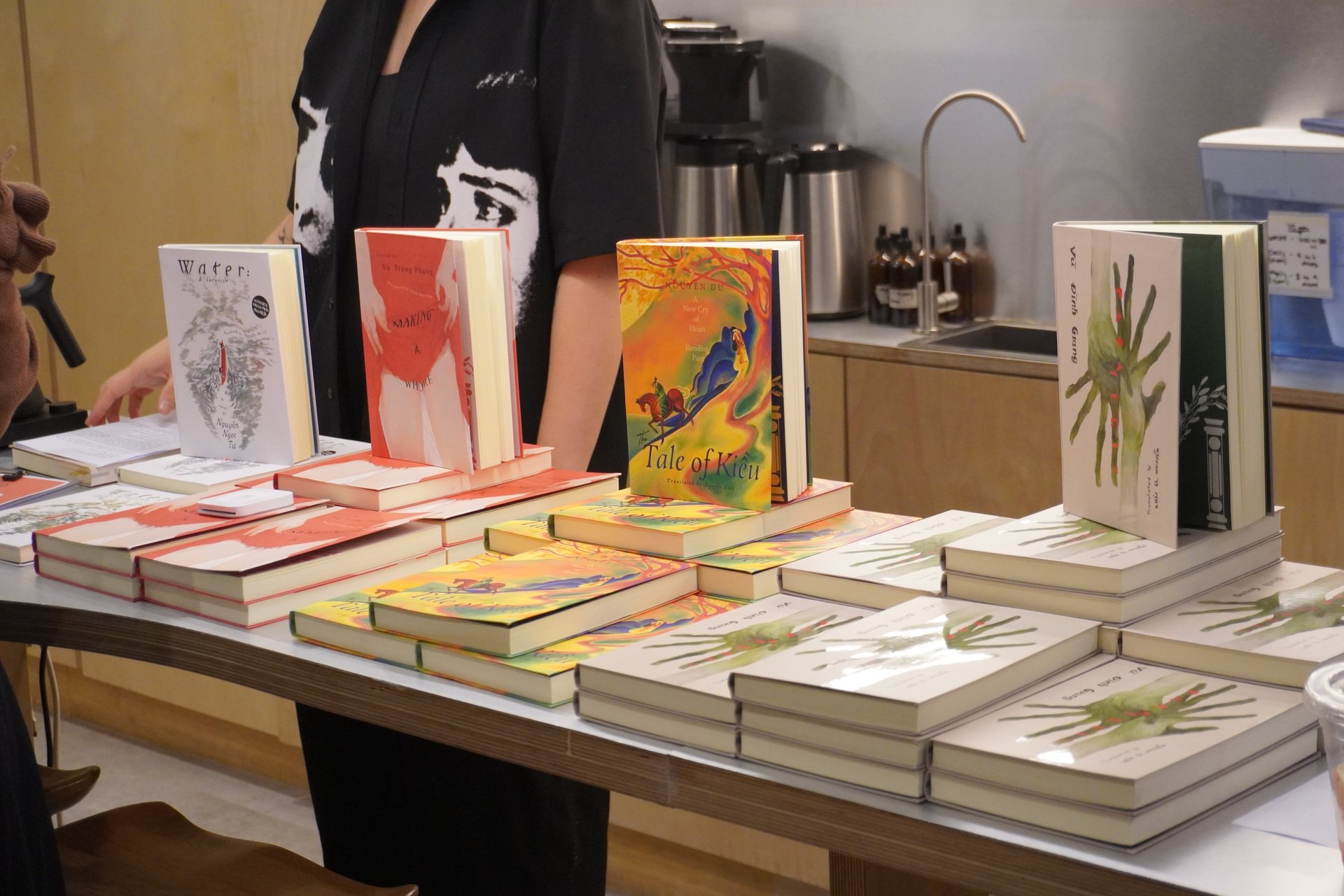
For any individual book, I look for three main things. First, does the work challenge or complicate the image that English-language readers currently have of Vietnam? Making a Whore by Vũ Trọng Phụng is a perfect example. A novel written in 1936, under French colonial rule, about a young woman’s sexual awakening—raw and satirical. Bringing it into English says: Vietnam in the 1930s was not simply a colonized society passively absorbing Western influence. It had its own internal cultural war about modernity, desire, and morality, and writers were getting censored for it. Second, is this work saying something really interesting? When we chose Parallels, it was because it’s the first Vietnamese literary work about homosexuality that moves beyond the cliché of its characters being sex workers or transvestites. It treats queerness with the same complexity and ambiguity that a Hollinghurst or an Édouard Louis would. That felt genuinely urgent. Third, is there a translator who is genuinely the right person for this particular text? I never commission a translation without knowing who will do it. The match between translator and text is sacred. Sometimes the translator comes to us with the book; sometimes we approach translators with a title we’ve identified. But we won’t proceed unless the chemistry is right. “Right” here means the respect and understanding of the original work, both its language and cultural/historical context.
Beyond the selection of individual titles, we are trying to build a catalog that argues for a particular vision of what Vietnamese culture is and can be. That means we are actively curating for range across form, gender, generations, and geography. Vietnamese literature is not a monolith, and we do not want to present it as one.
TTW: Can you tell us more about your collaboration with translators: how do you establish your relationships, what role do translators play in shaping your catalogue beyond the act of translation itself? Do translators approach you with ideas for translation, or do you solicit?
KT: It goes both ways, and the best relationships are the ones where a translator comes to us with something they are burning to do. Khải Nguyễn, who translated The Young Die Old by Nguyễn Bình Phương, first came to us with a finished translation of the work. It was a ten-year-long personal project of his, for which we are eternally grateful. After contracting the first work, he proposed to translate Parallels by Vũ Đình Giang, which is arguably a profound, defining work of Vietnamese queer literature. There was no other answer but yes. It was one of those serendipitous moments, since the book was already on my radar and I was going to ask if Khải himself was interested in translating it. He had read Parallels when it came out, and it had profoundly touched him. That kind of personal investment is irreplaceable—no amount of professional competence can substitute for a translator who has been living with a text for over a decade.
Another example is Nguyễn An Lý (winner of the American National Translation Award and several times English PEN Translates Award), who translated Water: A Chronicle by Nguyễn Ngọc Tư. Not only is she a fan of the author, but she is also a translator of extraordinary range—she brought Atwood, Ishiguro, Borges into Vietnamese—and she co-founded Zzz Review, an independent Vietnamese literary review. She is deeply embedded in the Vietnamese literary ecosystem, and her taste and judgment shape our awareness of what’s happening in contemporary Vietnamese writing. Our Vietnam-based advisor, Nguyễn Quyên, plays a similar role, helping us navigate the literary landscape and identify works that could resonate internationally.
PN: We see translators as co-creators and, in many cases, co-curators rather than mere service providers. They are, in many respects, the reason our books are possible. Their names will always be on the covers, and we made the deliberate choice to align them with royalties on the sales. We fight for that because it matters, both symbolically and practically. A translator who feels ownership over a project will always produce better work.
TTW: Many of the translators you collaborate with appear to be native—or perhaps multilingual or heritage speakers of Vietnamese. In your view, does effective translation require a specific linguistic or cultural profile? I’m asking in part because of the theme of our first issue—The Exophonic Translator.
KT: I want to answer it honestly, which means resisting the diplomatic response.
Yes, we are committed to working primarily with native Vietnamese speakers, and we’ve been explicit about this from the start. This is a deliberate choice, and I won’t pretend it’s a neutral one.
Here’s my reasoning: Vietnamese is a tonal language with six tones. Its literary tradition is deeply rooted in forms like lục bát (six–eight poetry couplets), and a relationship between sound and meaning that is simply inaccessible to someone who didn’t grow up hearing it. When Nguyễn Bình, who translated The Tale of Kiều for us, writes in his translator’s note about how lục bát divides lines into pairs of syllables where tone creates a stress-like emphasis, he’s describing something that would be very difficult to feel for a non-native speaker. And Kiều is a poem that lives or dies by how it feels.
But let me complicate my own position because your magazine’s theme demands it. The exophonic translator—the translator working from outside their native language—is not simply a lesser version of the native speaker. They bring something different: distance, estrangement, a capacity to hear what has become inaudible to the native ear through sheer familiarity. The French translator of Parallels, Yves Bouillé, is not Vietnamese, and he produced a translation that the author himself praised. So I’m not making a universalist claim.
What I am saying is this: for a press like ours, whose explicit mission is to resist the historical pattern of Vietnamese literature being mediated, interpreted, and sometimes distorted by non-Vietnamese voices, centering native and heritage speakers is a political and ethical choice as much as a linguistic one. The controversy around the translation of Bảo Ninh’s The Sorrow of War, where the translator’s interventions arguably reshaped the novel for Western consumption, is a cautionary tale we take seriously.
PN: I’d add a structural point. The translated literature world needs to be more honest about the fact that “anyone can translate from any language” is a principle that has historically benefited certain people more than others. Vietnamese literary practitioners have been systematically underrepresented in the English-language publishing ecosystem. We believe we had the privilege of encountering some of the most sophisticated readers of the Vietnamese literary tradition in existence, and we have conviction that they deserve to be the ones carrying it into English. For example, Nguyễn Bình, who translated The Tale of Kiều, is currently completing the first Vietnamese translation of Virgil’s Aeneid—while pursuing a PhD in astronomy. Uyên Nguyễn, translating Trần Dần’s Crossroads and Lampposts, is a historian at the National University of Singapore specializing in precisely the period the novel covers.
KT: I’d even say that historically, L2 translators who “dare” to translate into English or the language that is not their mother tongue are often greatly undermined. Their works are subjected to heavier criticism, with their English being questioned, reflecting an inherent valuing of the smoothness of translation over preserving the original text’s “aura” (to borrow Walter Benjamin’s term here). Our work here is to claim the valid, honorable places that these brilliant translators deserve to have and to help contribute to the varieties of Englishes that are constantly growing.
TTW: How closely do you work with translators during the editorial process, and what does that collaboration look like in practice?
KT: I personally follow every editorial process very closely and seek to communicate with the translator and the editor. Sometimes it is slow, it can occasionally be tense in the best possible way. There are recurring sites of difficulty: the question of whether to retain untranslatable terms or gloss them. Whether a footnote is an admission of defeat or an invitation. Whether a sentence that reads awkwardly in English is awkward because the translation is imperfect or because the original is deliberately strange. These are not questions with clean answers, and we’d be suspicious of any editorial process that treated them as if they were.
TTW: What are the biggest challenges you face as a small press working in translation—funding, distribution, marketing and visibility, or something else?
PN: I think it all comes down to market acceptance. We’re asking Western readers, who are overwhelmingly accustomed to Eurocentric literature, to pick up a book by a Vietnamese author they’ve never heard of, translated from a language they can’t read, published by a press that didn’t exist three years ago. We are compounding the friction points that together are formidable.
A lot of the friction we face specifically for Vietnamese literature is the lack of infrastructure. I strongly believe the commercial and critical success of Japanese or Korean literature in translation is the result of decades of deliberate investment. Cultural institutions, translation grant programs, festival presence, and coordinated representation. Someone had to build that infrastructure; success did not emerge organically solely from the quality of the writing.
Vietnamese literature has almost none of that. We are building from scratch: convincing rights holders in Vietnam that translation into English is an opportunity worth pursuing, while simultaneously convincing readers, booksellers, and prize juries on this side of the ocean that Vietnamese literature is a body of work worth engaging with seriously. Those are two very different conversations, happening at the same time, with the resources of a very small press.
TTW: How do you balance artistic risk with commercial sustainability?
PN: This is a conversation we regularly have with Kim, and we have landed somewhere counterintuitive: we think artistic risk is our commercial proposition.
We did consider pursuing books most likely to find a mainstream readership and making safer bets with a view to reaching profitability first. We chose not to. We decided to go with pieces that unsettle and surprise. We think that this is the only way we can be faithful to our mission. Also, in an incredibly crowded market, editorial boldness is possibly the only real differentiator.
Water: A Chronicle is probably a good illustration. Nguyễn Ngọc Tư herself compares her writing to a durian: some savor it; others recoil from the fruit’s pungent smell. Following publication, some readers shared candid feedback with us that whilst they appreciated the beauty of the prose, they found the story difficult to follow. We were aware that choosing this title as our inaugural release was a big commercial risk. We published it anyway because we believed the book was extraordinary. We were fortunate a PEN Translates Award confirmed our intuition was right.
The honest commercial reality is that so far we are operating at a loss. We have not reached the scale at which the catalog sustains itself. In the meantime, we are grateful to receive backing from cultural institutions: the Arts Council of England and English PEN both recognized the merit of what we are doing. That validation that we deserve to exist matters. However, I need to acknowledge that grants and prizes are uncertain and highly competitive, thus relying on them is not a viable business model.
The goal for us is to reach the point at which our distribution scale allows our catalog to sustain itself. It is not an easy objective, but we won’t get there by being more cautious.
TTW: What trends do you see emerging in contemporary Vietnamese writing that excite you?
KT: I have been on a jury to select submissions from new writers in Vietnam. I was genuinely excited by the volume of responses and the quality of the work I have seen. Despite the way that translated books, often from English and other major languages, have dominated the Vietnamese publishing scene, people are still writing voraciously. There is a generation of work being produced now that is formally experimental, that can be funny in a distinctly Vietnamese register.
TTW: As we close, is there anything you’d like to share about a project you’re working on now or a new book on the horizon?
KT: The one I keep coming back to is Treasury of Vietnamese Folk Tales. Folk tales are universal entry points—stories with structural echoes any reader recognizes. There is a Vietnamese Cinderella. There are trickster figures, wronged daughters, shape-shifting creatures who carry moral weight. These are the literary inheritance of an entire civilization, and they are almost entirely absent from English.
What excites me is that this is a book that can reach readers who would not necessarily walk into a bookshop looking for a contemporary Vietnamese novel. The role of women in folk tales, for instance, is a theme that resonates far beyond any specific cultural context—it is a door, not a destination.
We are also developing a cultural programme around the collection, including Echoing Whispers: Treasury of Vietnamese Folk Tales, a free exhibition at the Museum of the Home in London, running from 13 June to 26 July 2026. It brings these stories to life through visual art for audiences who might encounter Vietnamese storytelling for the first time—not through a page but through an image. The hope is to catch people who would never have come looking.
A new UK-based indie publisher is on a mission to (re)shape our understanding of Vietnamese literature through translation. Major Books is working to introduce texts we may never have encountered, but more importantly, perspectives that have been overlooked. Their growing portfolio is carefully curated to present a fuller, more nuanced understanding of what Vietnamese literature has to offer: brave new queer voices, satirical novels once banned for obscenity, retranslations of classical epic poems from the eighteenth century, and more.
Today we speak with Kim Trần and Pascal Nguyễn, co-founders and co-visionaries of the press, about the journey behind—and ahead of—their ambitious project.
Photo: Personal Archive
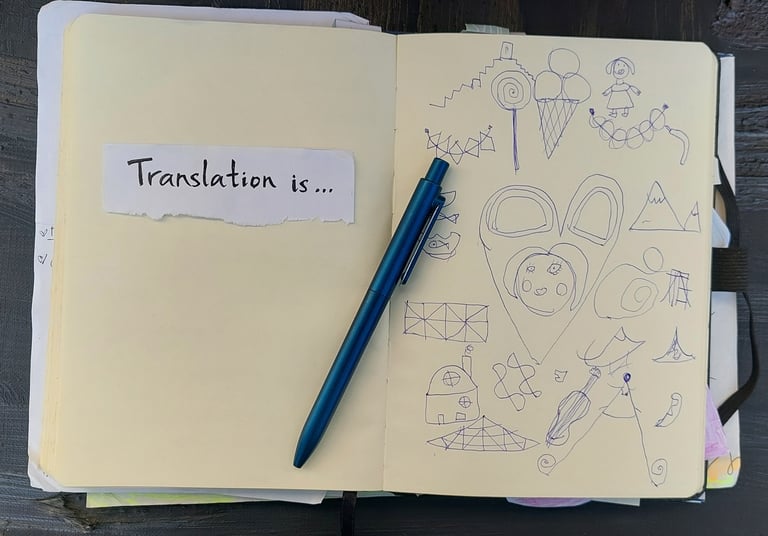
Kim and Pascal’s Translation Slam Book
Fidelity is… the impossible task of serving meaning, voice, rhythm, and cultural weight at once.
Ninja or superhero? Ninja: unseen but decisive.
A translation I fell in love with is… The Metamorphosis by Stanley Corngold, and recently Kevin Wang’s Spent Bullets.
My favorite misconception about translation is… that there is such a thing as a perfect, most accurate translation.
My favorite translation grant is… English PEN Translates.
Money is… the arbiter of what literature gets seen.
DROP US A LINE AT
submit@thethirdwheel.org
editors@thethirdwheel.org
© 2025. All rights reserved.
*Your viewing experience may vary depending on your browser or device settings. If you encounter any difficulties, please change your browser or adjust your device settings.