A Silly Epiphany
by Antonella Lettieri
When I was translating my third book, The Duke by Matteo Melchiorre, I experienced an odd phenomenon: I had the impression that the author was implicitly referencing, as a hidden homage, little turns of phrases and expressions from Your Little Matter by Maria Grazia Calandrone, the first book I translated. What I was noticing were the smallest details, really—the choice of a noun, the position of an adjective, a penchant for an adverb. Perhaps even a playful nod at the other’s last name surreptitiously sneaked into a key passage.
From social media, I had already gathered that the two authors—the first established, the second a debut—had met at a few book events and seemed to hold each other in high esteem. It was not too much of a stretch, therefore, to imagine that their mutual admiration might also bleed onto the page; my little satisfaction consisted simply in that a-ha moment of having caught one author winking at the other behind the reader’s back, an inside joke just between them—the accidental circumstance of my being the translator of both books potentially making me the only reader who had scrutinized both texts closely enough to catch the conversation going on in between the lines.
Then I started working on my fourth book, and the feeling came back, as powerful as before: the author Antonio Galetta, too, seemed to be referencing the tiniest snippets from my other authors. Again, possibly nothing too surprising—I only translate from one language, so the fact that these three authors might read one another, know one another in real life, and perhaps even reference one another’s work wasn’t really something outside the realm of possibility.
However, as the stack of translated pages grew taller and the network of hidden references among these books kept expanding, the whole thing began to feel slightly uncanny. How could it be that such a “loud” three-way conversation had been going on in secret, unbeknownst to anyone but me?
Funnily, it was only when I first sat down to write about this weird feeling that it finally dawned on me: the first book I’d translated had come out after the third. They were both published in 2022, only months apart, so it’s understandable that I might not have noticed the discrepancy to begin with.
And so, it’d taken me several months of working on my first full-length projects to realize that what I was observing was not an intricate web of reciprocal hidden homages and quotes, but rather my own hermeneutic individuality at work. Indeed, what brought those three books together was me, their translator into English, and the reverberations I was noticing were not objective cross-references, only visible to me because of my privileged viewpoint over the texts, but rather subjective echoes that kept vibrating within me long after I had moved on to the next book.
The words, expressions, and turns of phrase from each book had left very specific grooves in me, especially because I’d spent months and months turning the “problem” they posed over in my head, experimenting with different renditions, interrogating their hiddenmost meanings. Even when the needle of my focus had moved on to the next record, some of those grooves kept resonating within me as the two tracks hit the same beat.
So I had a second a-ha moment, even sillier than the first, when I thought I had unearthed the alleged “complot” of hidden references connecting the authors I was working on so lovingly. I discovered—oh, supreme silliness—that I bring my own individuality, background, and experience to my work, that I am the nexus where these books meet, and that it’s through my consciousness that these references come to be.
Now that I’ve sat down for the second time to try and flesh out these thoughts in a more cogent way, this realization feels more banal and insignificant than ever. The impression is that, had my first translation projects been three completely different but similarly resonant books, I would invariably have come to the same conclusions: first, that the three books were connected in secret, invisible ways; then, that I was their secret, invisible connection. But perhaps this realization is not quite as trivial as it might appear at first glance. Rather, it could be further proof of the fact that translation is a practice, and that the most illuminating epiphanies, much like the best solutions to translation problems, indeed reach us as we practice it.
In a recent interview, quite unexpectedly (another little epiphany), I found myself drawing a tentative distinction between a need for the translator’s visibility and the translation’s invisibility. Perhaps that point needs further reflection and better qualification—translation being a political act, it often needs to be utterly visible in itself—but that little flash of inspiration might also prove useful in this context.
These days, when we speak about the visibility of the translator, much of the focus goes to issues such as royalties and names on the cover. These practical matters are, of course, very important to the profession at large and to me personally. However, I believe that greater attention to the visibility of the translator should also mean a deeper understanding of the fact that all translation is interpretation and that this interpretation never happens in a vacuum.
The individual translator brings to each act of translation their own linguistic and cultural background, the entire catalog of books they’ve read (or never made it to), the music they grew up with, the contexts in which they acquired their working languages, the foods they most enjoy and the ones they haven’t discovered yet, the books they worked on in the past, the ones that got away, the inventory of translation problems they’ve faced to date, how they solved them, and the virtually endless list of their own extremely personal linguistic idiosyncrasies. Should this utterly peculiar collection of disparately sourced linguistic tools be fully “visible” in the translation at all times, and would that even be desirable? Probably not. Should we, as translators and readers, be profoundly aware of the fact that secret conversations among texts are indeed happening, though staged entirely within the translator’s consciousness? I think so.
Maybe this discovery is a rite of passage for every fledgling translator, and my epiphanies, whether silly or not, were simply my own way of stumbling into a realization that each translator has had to come to before through their own practice. But now I do believe, on a more fundamental level, that the consciousness of each translator is a prism that refracts the light of the source text in a unique way, and that it couldn’t be otherwise...
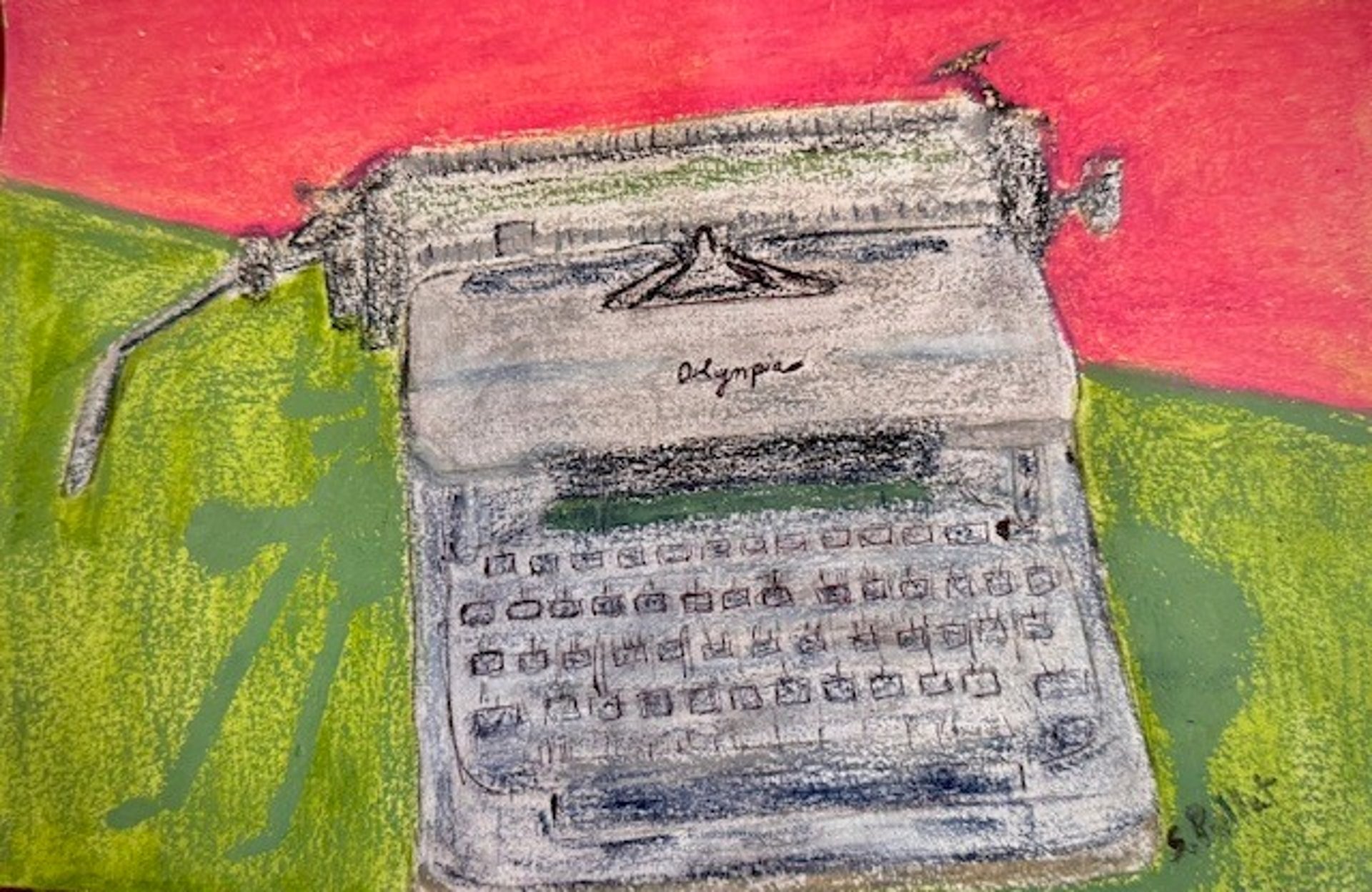
Artwork by Susan Pollet
Antonella Lettieri is a translator working between English and Italian. Her previous translations include Maria Grazia Calandrone’s Your Little Matter (Foundry Editions, 2024), Roberta Recchia’s All That Is Left of Life (Dialogue Books, 2025), and Matteo Melchiorre’s The Duke (Foundry Editions, 2025), which was longlisted for the International Booker Prize. She was the National Centre for Writing’s Emerging Translator Mentee for Italian in 2023 and won the John Dryden Translation Competition in the same year. Her translation of Maria Grazia Calandrone’s Your Little Matter was granted the 2024 PEN Grant for the English Translation of Italian Literature and won the 2025 TA First Translation Prize.
Antonella’s Translation Slam Book
Fidelity is… a notion entirely dependent on the book: every book demands its own very specific brand of fidelity.
Ninja or superhero? Neither. Rather, a competent professional fuelled by passion.
Full-time job or glorified hobby? Full-time job.
Money is… something we need to talk about more.
DROP US A LINE AT
submit@thethirdwheel.org
editors@thethirdwheel.org
© 2025. All rights reserved.
*Your viewing experience may vary depending on your browser or device settings. If you encounter any difficulties, please change your browser or adjust your device settings.